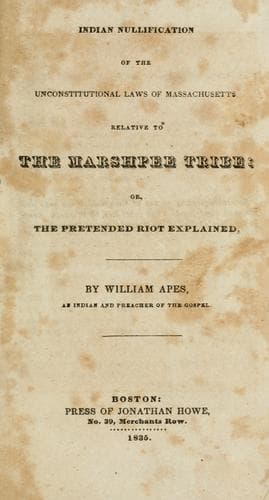
Indian Nullification of the Unconstitutional Laws of Massachusetts Relative to the Marshpee Tribe: Or, the Pretended Riot ExplainedApess, William
History
Indian Nullification of the Unconstitutional Laws of Massachusetts Relative to the Marshpee Tribe: Or, the Pretended Riot Explained
Apess, William
Indians of North America -- Legal status, laws, etc.; Mashpee Indians -- Land tenure; Mashpee Indians -- Legal status, laws, etc.
Whereas, certain resolutions have been made by us, the
Marshpee Indians, in reference to our plantation, we do
hereby solemnly declare, upon the security of the Governor's
Counsel,[7] that we shall be righted; and that there shall be
a change of government, if necessary, and that the governor
has pledged himself to do right, and that the property sold
for money or otherwise disposed of, shall be refunded to us
again, and that justice shall be done. Now, in consideration
thereof, we do hereby guaranty to our white neighbours that
they shall not be molested in their lawful concerns upon our
plantation, provided that no white man meddles or interferes
in any way whatever in our lawful affairs; and that you may
understand that it is so, we say the resolutions are revoked,
and we will wait with pleasure the sitting of the Legislature.
Done by order of the Marshpee Tribe, July 6, 1833.
DANIEL AMOS, _President_.
ISRAEL AMOS, _Secretary_.
Soon after this, the Commissioner departed, and I saw him no more till
the sitting of the General Court. About this time our affairs got into
the public prints, and it was reported through the whole land that
there were hostile movements among the Indians at Cape Cod, or
Buzzard's Bay. All the editors were very willing to speak on the
favorite topic of Indian wrongs; but very few of them said any thing
about redress. On this head they were either silent or against us.
Here and there was found one liberal and independent enough to speak
in our behalf. Some of these articles shall be given, that it may be
seen who were for or against our rights and privileges. It will be
proper to state in the first place, however, that from July 4, to the
sitting of the Court of Common Pleas, in September, there was little
disturbance upon the plantation. We thought, from what we heard among
the whites that they were inclined to spare no pains to frighten
us; but we listened patiently and remained quiet, according to our
promise.
In August, we had a four-day meeting, which was the means of much
good. Twelve Indians were redeemed from sin, and during the eighteen
months that I have known them, the power of God has been manifested
in the conversion of some thirty. God forbid that I should glorify
myself; I only mention the circumstance to show that the Marshpees are
not incapable of improvement, as their enemies would have the world
suppose. But, under these circumstances, is it not natural for the
Indians to think that their missionaries have cared less for saving
their souls than for filling their own pockets, and that their
thousands have been expended on them to very small purpose? I do think
that the result of this meeting was in no wise pleasing to our white
enemies.
Public-domain text, read in full here on John Shaqi.
Reviews
Reviews
No reviews yet
Be the first to share your thoughts on this work.
Join the Discussion
Join the discussion
Sign in to leave a comment or review.
Sign InorCreate an account