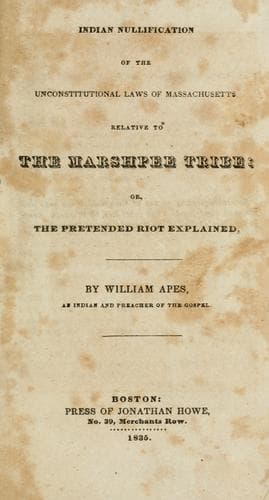
Indian Nullification of the Unconstitutional Laws of Massachusetts Relative to the Marshpee Tribe: Or, the Pretended Riot ExplainedApess, William
History
Indian Nullification of the Unconstitutional Laws of Massachusetts Relative to the Marshpee Tribe: Or, the Pretended Riot Explained
Apess, William
Indians of North America -- Legal status, laws, etc.; Mashpee Indians -- Land tenure; Mashpee Indians -- Legal status, laws, etc.
At harvest time the reapers cut their grain and carried it to their
granaries. But they were under the control of their task masters. A
dispute arose. A woman whose husband was absent, doing business upon
the great waters, claimed a portion of the grain, while the overseers
maintained that it belonged to them. She applied for assistance to one
of the true proprietors, who, in the presence of five or six men who
were with the overseer's team, unloaded it, and placed the grain where
it ought to have been. I was present and happened to smile at this
novel proceeding, which, I suppose was the cause of a prosecution that
presently took place for trespass. My horse had bitten off five or six
rye heads in a rye field, for which enormity his owner was obliged to
pay ten dollars, though the actual damage was not to the value of six
cents. I will not retort the petty malice which prompted this mean act
of revenge, by mentioning names. I now proceed to mark out the state
of public feeling, by some extracts from the newspapers. The following
is from the New Bedford Press, of June 1, 1833:
MARSHPEE INDIANS.
The remnants of that race of men who once owned and inhabited
the forests and prairies of the Old Colony that have new
given place to large and populous villages and the busy hum
of _civilized_ man, are, it would seem, somewhat dissatisfied
with the manner in which they are governed by the State
authority. Communications illustrative of the condition of
the _Marshpee Indians_ in the County of Barnstable, have been
forwarded to us by the agent of the tribe, by which it appears
that they have been abused. Intelligence from other quarters
comes fraught with bitter complaint, and there can be
no manner of doubt that too ample room remains for the
improvement of their condition. The communications at hand
advise the Indians to stand out for their right to appoint
their own overseers, and do all business now especially done
by the State. That they ought to be allowed this privilege,
(if _privilege_ it may be called,) there is no question; but
there is a question, whether this is the first important step
to be taken. By a list of names which accompanies our advices,
it appears that very few are able to write their own names,
their mark being affixed instead; and in addition to this, we
are informed that there are many who cannot even read. With
this view of their condition the correct and efficient course
to be pursued would seem to be that of sending _Education
Missionaries_ among them, that in contending for their rights,
of which they say they are deprived, they may be enabled to
act understandingly.
Public-domain text, read in full here on John Shaqi.
Reviews
Reviews
No reviews yet
Be the first to share your thoughts on this work.
Join the Discussion
Join the discussion
Sign in to leave a comment or review.
Sign InorCreate an account