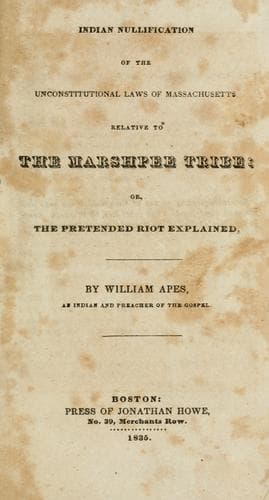
Indian Nullification of the Unconstitutional Laws of Massachusetts Relative to the Marshpee Tribe: Or, the Pretended Riot ExplainedApess, William
History
Indian Nullification of the Unconstitutional Laws of Massachusetts Relative to the Marshpee Tribe: Or, the Pretended Riot Explained
Apess, William
Indians of North America -- Legal status, laws, etc.; Mashpee Indians -- Land tenure; Mashpee Indians -- Legal status, laws, etc.
He was questioned as to his own right to be on the plantation,
to which he does not belong, and finding all argument useless
with him, Apes was arrested in the assembly, (where he was
acting as moderator,) upon a warrant for assault and trespass,
in unloading the teams of Mr. Sampson. The Indians were
perfectly quiet, and Apes having been bound over for his
appearance to take his trial, in the sum of $200, he was
immediately bailed by Mr. Ewer, a Justice of the Peace, and
was not committed to jail, as has been represented. After his
arrest, he expressed some contrition, and admitted he had gone
too far. The ultimate understanding appears to be with the
Indians, that they will offer no further resistance, but wait
patiently for a redress of grievances, until the meeting of
the Legislature, when they confidently expect to have their
guardianship removed. As an evidence of their peaceable
disposition, "President" Amos, at the request of Mr. Fiske,
gave up the key of the Meeting-house, for Rev Mr. Fish to
occupy the pulpit, and asked as a favor, that the Indians
might occupy it half the time. The result of the mission
of Mr. Fiske, is therefore very favorable, and if a similar
course is pursued hereafter, there will be no further
difficulty with the tribe. They should be treated with
all possible lenity and kindness, for the honor of the
Commonwealth.
The Indians would not consent to see Mr. Fiske at first, because they
did not like to meet their enemies off their own ground, and I
presume they would not have consented to do so to this day. As to the
Counsellor's meeting us alone, it was the especial direction of
the Governor that he should hear the parties separately, because,
supposing the government to be oppressive, it seemed to him that the
Indians would be afraid to speak plainly in presence of their masters,
or proffer their complaints. The Indians wished to do nothing in a
corner; but rather to proceed with an open and manly spirit, that
should show that they were unjustly accounted abject and willing
slaves. As to my opinion of the powers of the Governor, I have already
admitted that I was in error; for I am not a man skilled in legal
subtleties. My reason for pressing our claims so strongly was, to make
the way easy for my brethren, till something could be done for them.
The Indians were requested to give up their own Meeting-house to
a gentleman who did not come at their request, and to gather other
people into it to suit his convenience. The Indians asked for their
own house for only half the time, and even this was denied them.
The law not bearing out their petition, they could only obtain it by
force, and, finding this to be the case, they forbore.
Public-domain text, read in full here on John Shaqi.
Reviews
Reviews
No reviews yet
Be the first to share your thoughts on this work.
Join the Discussion
Join the discussion
Sign in to leave a comment or review.
Sign InorCreate an account