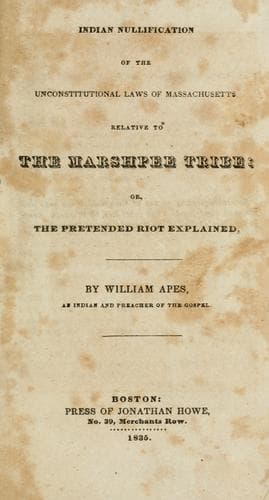
Indian Nullification of the Unconstitutional Laws of Massachusetts Relative to the Marshpee Tribe: Or, the Pretended Riot ExplainedApess, William
History
Indian Nullification of the Unconstitutional Laws of Massachusetts Relative to the Marshpee Tribe: Or, the Pretended Riot Explained
Apess, William
Indians of North America -- Legal status, laws, etc.; Mashpee Indians -- Land tenure; Mashpee Indians -- Legal status, laws, etc.
The question is, how can a man do good among a people who do not
respect him or desire his presence, and who refuse to hear him preach?
Yet Harvard College has forced such an one on the Marshpees against
their will, right or wrong.
I heard a white lady observe, that Mr. Fish was not a preacher for
every one; as though he was not fit to preach to any but us poor
ignorant Indians. Nevertheless, if any people need a talented,
enterprising preacher, we are the very ones. Some may suppose Mr. Fish
to be a Unitarian. He was, when he was first settled at Marshpee;
but his opinions underwent a change soon after, and he became what is
commonly called an orthordox Congregationalist. In order to be a good
one, he ought to make one more change--a change of inclination, to
force himself on poor Indians. One who has such an inclination cannot
be a good member of any sect, or an honor to it. Such a person can be
no ornament to any ecclesiastical body. I would not have it inferred
from this that a breath of reproach is in my mind, or in those of my
brethren against any denomination of Christians. We love all who love
the Lord Jesus in sincerity.
I expressed no contrition because I thought I had acted morally wrong,
or had asked any thing more than was right; but because I had mistaken
the _law_, which in this case was a very different thing from justice.
The next article is from the Barnstable Journal, of July 25. It will
serve to show that though the matter had been perfectly explained to
the inhabitants of Barnstable County; yet it contained some of our
worst enemies as well as best friends. Our enemies were those in
office, and those under their influence. The majority believed the
Indians to be wronged, and ought to have had redress; and these were
unable to act in our behalf. Those who did act were either our enemies
or persons who had no minds of their own, and were led by them in all
they did. Many of them did, nevertheless, sympathise with the Indians,
and pitied them when cast into prison, for all men can appreciate the
blessing of liberty.
MARSHPEE INDIANS.
MESSRS. EDITORS,
Public-domain text, read in full here on John Shaqi.
Reviews
Reviews
No reviews yet
Be the first to share your thoughts on this work.
Join the Discussion
Join the discussion
Sign in to leave a comment or review.
Sign InorCreate an account