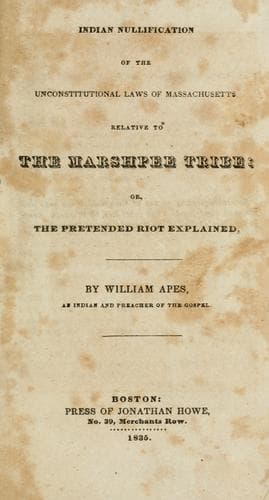
Indian Nullification of the Unconstitutional Laws of Massachusetts Relative to the Marshpee Tribe: Or, the Pretended Riot ExplainedApess, William
History
Indian Nullification of the Unconstitutional Laws of Massachusetts Relative to the Marshpee Tribe: Or, the Pretended Riot Explained
Apess, William
Indians of North America -- Legal status, laws, etc.; Mashpee Indians -- Land tenure; Mashpee Indians -- Legal status, laws, etc.
_Dear Sir_--With regret I say that your white brethren still
think it a privilege to impose upon us here. The men upon
our plantation were gathering their rye harvest, and the poor
women whose husbands were at sea, who had let out their land,
confidently expected to have their share, but it was taken
from them by unjust men, and not so much as a spear of it left
to sustain them, or even the promise of help or aid in any
way; it was not taken for debt and no one knows for what. The
overseers have now become displeased, and choose at this time
to use their great power. I hope we shall not have to call
upon the State to protect us, but if we are imposed upon in
this manner, we believe we shall. And while we are willing
to be still and peaceable, we think that those of our white
friends, with the light they possess, ought to show as much
of the spirit of kindness as poor ignorant Indians. The
Legislature has bound the poor Indians as they have. The
Indians would propose one thing. We have some white men here
who will smuggle rum, and sell it to the Indians, and as they
have no license, they ought to be stopped. We are happy to say
that many of our Indians are temperate, but we wish them
all to be, and we want some way to have a stop put to these
things, for these white men are ten times worse than any
of the Indians. I might name a Fuller, a Chadwick, and a
Richardson; we really wish that the honorable Legislature
would place guardians over them, to keep them from wasting our
property in this way. While I was absent, there was a man
that sued me for trespass, and tried the case without my
information. What kind of law is this? I had the liberty of
baiting my horse in a field. A man had rye in a field he did
not hire, but took it upon shares. My horse got in his rye,
but six cents would pay all the damage. But the action is not
damage, but trespass, and that done unknown to me.
It is impossible to give you the details of wrongs imposed
upon the Indians. We are to be accused by our enemies, tried
by them, and condemned by them. We can get redress no where,
unless we trouble the government all the while, and that we
are delicate to do.
Now we believe that some of these things published abroad
would do good, and we should have more peace.
Yours, most obediently."
We have received another communication from Marshpee, upon the
same subject.
Public-domain text, read in full here on John Shaqi.
Reviews
Reviews
No reviews yet
Be the first to share your thoughts on this work.
Join the Discussion
Join the discussion
Sign in to leave a comment or review.
Sign InorCreate an account