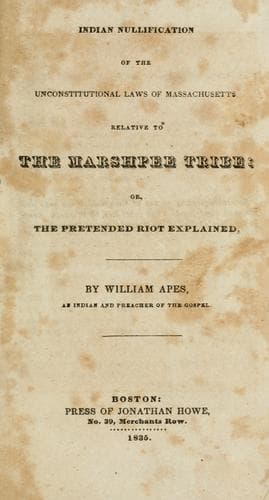
Indian Nullification of the Unconstitutional Laws of Massachusetts Relative to the Marshpee Tribe: Or, the Pretended Riot ExplainedApess, William
History
Indian Nullification of the Unconstitutional Laws of Massachusetts Relative to the Marshpee Tribe: Or, the Pretended Riot Explained
Apess, William
Indians of North America -- Legal status, laws, etc.; Mashpee Indians -- Land tenure; Mashpee Indians -- Legal status, laws, etc.
Mr. COBB said that he had agreed to exchange with Mr. FISH, on the
Sabbath following, but as it was inconvenient for him to do so, he
would give me a line to him. With this furtherance I set forward, and
arrived at Mr. FISH's house before sunset, informing those I met on
the way that I intended to preach on the next day, and desiring them
to advise others accordingly. When I made my business known to Mr.
FISH, he treated me with proper kindness, and invited me to preach for
him. When I awoke in the morning, I did not forget to return thanks to
God for his fatherly protection during the night, and for preserving
me in health and strength, to go through the duties of the day. I
expected to meet some hundreds of the tribe, and to hear from their
lips the sweet song of salvation which should prepare their minds for
the words of life, to be delivered by one of the humblest servants of
God. I hoped that grace might be given to me to say something to my
poor brethren that might be for their advantage in time and eternity;
after which I thought I should see their faces no more. I looked to
see them thronging around their missionary in crowds, and waited for
this agreeable sight with great anxiety.
The time appointed for the service was half past ten. When it arrived,
we got into our carriages and proceeded to the Meeting-house, which
was about two miles and a half distant. The sacred edifice stood in
the midst of a noble forest, and seemed to be about a hundred
years old; circumstances which did not render its appearance less
interesting. Hard by was an Indian burial ground, overgrown with
pines, in which the graves were all ranged North and South.
A delightful brook, fed by some of the sweetest springs in
Massachusetts, murmured beside it. After pleasing my eyes with this
charming landscape, I turned to meet my Indian brethren and give
them the hand of friendship; but I was greatly disappointed in the
appearance of those who advanced. All the Indians I had ever seen were
of a reddish color, sometimes approaching a yellow; but now, look to
what quarter I would, most of those who were coming were pale faces,
and, in my disappointment, it seemed to me that the hue of death sat
upon their countenances. It seemed very strange to me that my brethren
should have changed their natural color, and become in every respect
like white men. Recovering a little from my astonishment, I entered
the house with the missionary. It had the appearance of some ancient
monument set upon a hill-top, for a landmark to generations yet
unborn. Could Solomon's temple have been set beside it, I think no one
would have drawn an architectural comparison. Beautiful as this place
was, we had little time to admire it; something more solemn demanded
our attention. We were to prepare ourselves for a temple more splendid
than ever was built by hands. When the congregation were seated, I
arose and gave out the psalm. I now cast my eyes at the gallery, that
Public-domain text, read in full here on John Shaqi.
Reviews
Reviews
No reviews yet
Be the first to share your thoughts on this work.
Join the Discussion
Join the discussion
Sign in to leave a comment or review.
Sign InorCreate an account