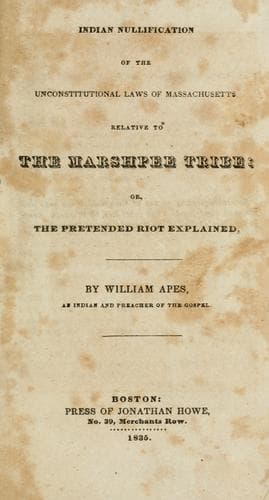
Indian Nullification of the Unconstitutional Laws of Massachusetts Relative to the Marshpee Tribe: Or, the Pretended Riot ExplainedApess, William
History
Indian Nullification of the Unconstitutional Laws of Massachusetts Relative to the Marshpee Tribe: Or, the Pretended Riot Explained
Apess, William
Indians of North America -- Legal status, laws, etc.; Mashpee Indians -- Land tenure; Mashpee Indians -- Legal status, laws, etc.
Having partook of some refreshment, we again met to worship God in the
School-house; where I believe that the Spirit of the Lord was revealed
to us. Then, wishing to know more of their grievances, real or
supposed, and upon their invitation, I appointed several meetings;
for I was requested to hear their whole story, and to help them. I
therefore appointed the twenty-first of May, 1833, to attend a council
to be called by my brethren. In the mean while I went to Falmouth,
nine miles distant, where I held forth upon the civil and religious
rights of the Indians. Some, who apparently thought that charity
was due to themselves, but not to the red men, did not relish the
discourse; but such as knew that all men have rights and feelings,
and wished those of others to be respected as well as their own, spoke
favourably of it. Of this number was Mr. Woodbury, the minister, who
thought it would do good. I then returned to Marshpee, to attend the
council.
The meeting was held in the school-room. Business commenced at about
nine in the morning, and continued through the day. The first that
arose to speak was an Indian, Ebenezer Attaquin by name. Tears flowed
freely down his time-furrowed cheeks, while he addressed us in a
manner alike candid and affectionate. The house was well filled.
After listening patiently to the tale of their distresses, I
counselled them to apply for redress to the Governor and Council. They
answered, that they had done so; but _had never been able to obtain a
hearing_. The white agents had always thrown every obstacle in their
way. I then addressed them in a speech which they all listened to with
profound attention.
I began by saying that, though I was a stranger among them, I did
not doubt but that I might do them some good, and be instrumental in
procuring the discharge of the overseers, and an alteration of the
existing laws. As, however, I was not a son of their particular tribe,
if they wished me to assist them, it would be necessary for them to
give me a right to act in their behalf, by adopting me; as then our
rights and interests would become identical. They must be aware that
all the evil reports calumny could invent, would be put in circulation
against me by the whites interested, and that no means to set them
against me would be neglected. (Had the inspiration of Isaiah spoken
these words, they could not have been more fully accomplished, as is
known to the whites of Barnstable County, as well as the Indians.)
Mr. Ebenezer Attaquin, being one of the prayer leaders, replied first,
and said, "If we get this man to stand by us, we must stand by him,
and if we forsake him after he undertakes for us, God will forsake us
also."
Mr. Ezra Attaquin wished to know if I could not come and dwell with
them, as so I could do them more good than if abiding at a distance.
Mr. Ebenezer Attaquin said in reply, that if such a chance should be
offered to a white man, he would be very glad to accept it.
Public-domain text, read in full here on John Shaqi.
Reviews
Reviews
No reviews yet
Be the first to share your thoughts on this work.
Join the Discussion
Join the discussion
Sign in to leave a comment or review.
Sign InorCreate an account