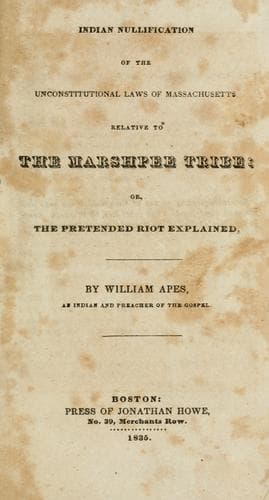
Indian Nullification of the Unconstitutional Laws of Massachusetts Relative to the Marshpee Tribe: Or, the Pretended Riot ExplainedApess, William
History
Indian Nullification of the Unconstitutional Laws of Massachusetts Relative to the Marshpee Tribe: Or, the Pretended Riot Explained
Apess, William
Indians of North America -- Legal status, laws, etc.; Mashpee Indians -- Land tenure; Mashpee Indians -- Legal status, laws, etc.
Mr. Bayley, the missionary on the Vineyard, we understand has but
two hundred dollars a year from Harvard College, while Mr. Fish, at
Marshpee, has between four and five hundred, and wrongly uses as
his own about five hundred acres of the best land on the plantation
belonging to the Indians. The Legislature in 1809, took this land from
the Indians, without any right to do so, as we think, and thus
compel them, against the Constitution, to pay out of their property
a minister they never will hear preach. Is this religious liberty
for the Indians? Mr. Fish is now cutting perhaps, 200 cords of wood,
justly belonging to the Indians, when there is scarce five who will
go and hear him preach in the Meeting-house, erected by the British
Society for propagating the gospel among the Indians, and given to the
Indians, but in which Mr. Fish now preaches to the whites, (having but
one colored male member of his church,[1]) and keeps the key of it,
for fear that its lawful owners, the Indians, should go in it, without
his leave. He will not let them have it for holding a camp meeting, or
for any religious purpose.
Last August we invited Mr. Hallett to come and address us on
Temperance, and to explain to us the laws. We appointed to meet at the
Meeting-house, as the most central place. Mr. Fish at first refused to
let the Indians go into their own Meeting-house, and the people began
to assemble under the trees, when it was proposed for the Selectmen to
go and ask for the key, that they might see if Mr. Fish would refuse
it. At this moment, a white man who had been there some time, and had
tried to pick a quarrel with Mr. Hallett and the Indians,[2] said he
was sent by Mr. Fish with the key, and would let the people in, if
they would promise to come out when _he_ told them to. Mr. Hallett
declined going in on such terms, and proposed to hold the meeting
under the trees. This shamed the messenger of Mr. Fish, and he opened
the door, and the people went in, where Mr. Hallett addressed them.
While the Indians were thus gratified in meeting their friends, and in
hearing good advice from Mr. Hallett, on temperance and their affairs,
Mr. Fish's messenger interrupted the speaker, in a very abrupt and
indecent manner, and tried to bring on a quarrel and break up the
meeting. Captain George Lovell, always a friend to the Indians,
tried to keep Mr. Crocker still, and Mr. Hallett declined having any
controversy, yet the man persisted in his abuse, until he broke up
the meeting. Had it been thought best, this insulting ambassador would
have been put out of the house as a common brawler and disturber; but
Mr. Hallett forbore to have any controversy with him. He afterwards
met the Indians in their School-houses, and delivered two addresses
without interruption from the emissaries of Mr. Fish. This is a
sample of the way the Indians have been treated about their own
Meeting-house. In some of the old petitions, the Indians speak of
Public-domain text, read in full here on John Shaqi.
Reviews
Reviews
No reviews yet
Be the first to share your thoughts on this work.
Elsewhere in the archive
Join the Discussion
Join the discussion
Sign in to leave a comment or review.
Sign InorCreate an account