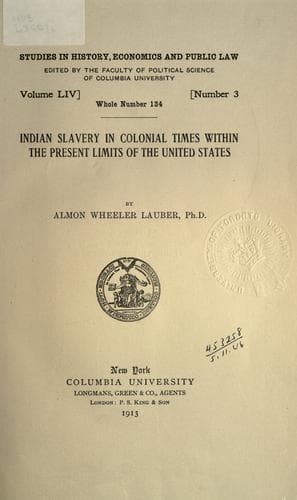
Indian slavery in colonial times within the present limits of the United StatesLauber, Almon Wheeler
History
Indian slavery in colonial times within the present limits of the United States
Lauber, Almon Wheeler
Indians of North America; Indians, Treatment of -- United States; Slavery -- United States; Thesis (Ph. D.)
Not infrequently the colonial authorities were called upon to furnish
protection to the owners of Indian slaves against their seizure by
the free Indians, or against fugitive Indian slaves being hidden and
retained by the tribes. To effect the return of such slaves special
inducements were offered by the colonial government from time to time.
At the close of the Pequot War an agreement was made by the chief,
Miantonomo, and the Massachusetts government, by which the former
promised to seize such Pequot slaves as escaped, and return them to
their owners.[784] On June 2, 1641, the general court of Massachusetts
made a similar agreement with Lieutenant Willard of Concord, Ensign
Holman of Dorchester, and Sergeant Collacot of Dorchester. As a partial
return for the monopoly of the Indian trade granted them, these men
agreed to demand, wherever they should find them, all fugitive Pequot
slaves that belonged to the English.[785] A similar request for
protection is found in New York, where two widows petitioned governor
and council, May 16, 1717, regarding two Indian slaves who were
secreted by the Indians of Pekkemeck.[786] Events in North Carolina,
following the Tuscarora War, offer numerous illustrations of colonial
action taken to secure the return of such fugitives. The Indian slaves
in the colony, consisting largely of the captive Tuscarora, frequently
escaped and took refuge with the free Indians of their tribe. The
Indians neglected to return these runaways, and the council was
compelled to call many times upon “King Blount” to compel his people
to return the slaves according to his agreement with the Carolina
government. Such action is recorded as late as 1731.[787]
Sometimes this protection of slave owners in their property rights
assumed intercolonial importance. Such a recognition of property rights
occurred in the articles of federation of the United Colonies of New
England, 1643, provision: “If any servant run away from his master
into any of these confederated jurisdictions, ... in such case, upon
certificate of one magistrate in the jurisdiction of which the said
servant fled, or upon other due proof, the said servant shall be
delivered, either to his master or any other that pursues and brings
such certificate or proof”.[788]
Public-domain text, read in full here on John Shaqi.
Reviews
Reviews
No reviews yet
Be the first to share your thoughts on this work.
Elsewhere in the archive
Join the Discussion
Join the discussion
Sign in to leave a comment or review.
Sign InorCreate an account