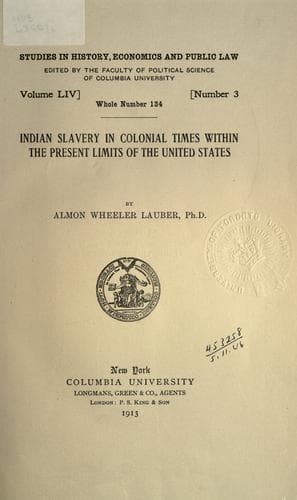
Indian slavery in colonial times within the present limits of the United StatesLauber, Almon Wheeler
History
Indian slavery in colonial times within the present limits of the United States
Lauber, Almon Wheeler
Indians of North America; Indians, Treatment of -- United States; Slavery -- United States; Thesis (Ph. D.)
In July, 1682, Plymouth provided that if any Indian who was a servant
of the English should run away, “such Indians where such a runaway
Indian is come, shall forthwith give notice of the runaway to the
Indian constable, who shall immediately apprehend such Indian servant
and carry him or her before the overseer or next magistrate.”[795]
At a meeting, January 9, 1713, the council of North Carolina considered
the matter of two Indian slaves sent to the colony from Virginia,
and found that they belonged to two residents of South Carolina from
whom, presumably, they had been stolen. The council, acknowledging the
owners’ claim to the right of possession, ordered that the Indians be
delivered to Colonel James Moore “for the use and on behalf of the
owners.”[796]
A case in Massachusetts shows a colonial government remunerating a
citizen for an Indian slave taken from him by governmental authority.
During King Philip’s War, one George Speere bought an Indian from
Captain Hull who had been empowered by the council to make sale of
Indian captives at that time. The council, by warrant of the constable
of Braintree, took away the Indian boy for some reason. Speere
complained of the loss of his property, after, as he said, he had
brought it to a “very tractable and profitable state”, and petitioned
to have his Indian boy returned to him, or to be given his value. The
council accordingly granted him the value.[797]
As in the case of other property, the colonial courts were sometimes
called upon to settle disputes regarding the ownership of Indian
slaves. Two events in Massachusetts and North Carolina are cases in
point. In 1684, the Massachusetts Court of Assistants was called
upon to settle a case of disputed ownership which had been appealed
from the County Court of Salem.[798] On November 24, 1777, complaint
was made to the North Carolina House of Commons by a slave owner who
had been dispossessed of his Indian slave by two other Carolinians.
The House appointed a committee to investigate the matter.[799]
Similar instances in other years are recorded in connection with North
Carolina.[800]
With the growth of the idea of property incident to the slavery
status, the “early transition of the slave from personal estate to a
chattel real, or real estate with accompanying incidents, was easy
and natural.”[801] Under the caption of “property” both negro and
Indian slaves were subject to taxation like other property, either for
colonial revenue in general or to meet local expenses. Moreover in
certain colonies both Indian and negro slaves were assigned the double
character of persons subject to a poll tax and property subject to a
property tax.
Public-domain text, read in full here on John Shaqi.
Reviews
Reviews
No reviews yet
Be the first to share your thoughts on this work.
Elsewhere in the archive
Join the Discussion
Join the discussion
Sign in to leave a comment or review.
Sign InorCreate an account