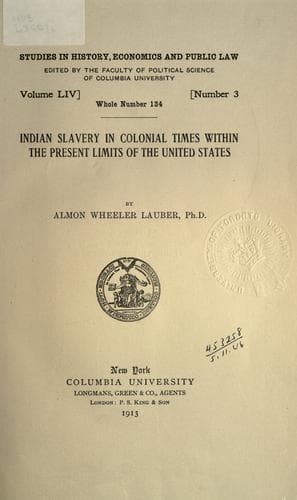
Indian slavery in colonial times within the present limits of the United StatesLauber, Almon Wheeler
History
Indian slavery in colonial times within the present limits of the United States
Lauber, Almon Wheeler
Indians of North America; Indians, Treatment of -- United States; Slavery -- United States; Thesis (Ph. D.)
South Carolina, in the act of 1690, provided “that all slaves ... as to
the payment of debts shall be deemed and taken as all other goods and
chattels, ... and all negroes and slaves shall be accounted as freehold
in all other cases whatsoever and descend accordingly”.[802] Middleton,
president of the council, consequently declared, in 1725, that negroes
were real property, such as houses and lands, in Carolina.[803] Yet
they were always returned as personal property in the inventories of
intestates.[804] This condition continued until 1740, when it was
declared that negroes and Indian slaves should be reputed and adjudged
in law to be chattels personal in the hands of their owners and
possessors and their executors, administrators and assigns.[805]
Various tax acts were passed from time to time for special reasons, and
in some of these Indian slaves, along with negroes, were a part of the
basis of taxation, being rated as property without specification as to
real or personal, along with goods, lands, cattle and white servants.
Such an act was passed in 1703.[806] The act contained the general term
“slaves”, which, of course, included Indian slaves by implication.
A tax on polls was generally selected by the colonies as the chief
source of revenue. In accordance with this idea of taxation North
Carolina during the eighteenth century regarded Indian slaves as
taxables. In the earliest legislative action of the colony taxables
were declared to be every white male aged sixteen years, and every
slave, negro, mulatto, or Indian, male or female, aged twelve
years.[807] By the act of 1750, furthermore, a taxable was every white
man of sixteen years of age, every negro, mulatto or mustee, and every
other person of mixed blood to the fourth generation, twelve years of
age.[808]
Public-domain text, read in full here on John Shaqi.
Reviews
Reviews
No reviews yet
Be the first to share your thoughts on this work.
Elsewhere in the archive
Join the Discussion
Join the discussion
Sign in to leave a comment or review.
Sign InorCreate an account