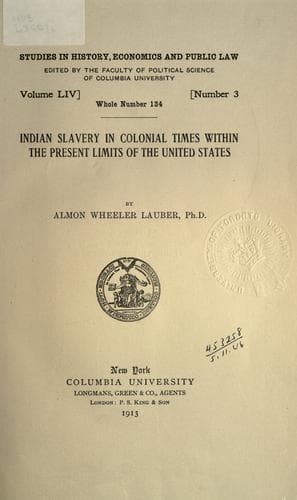
Indian slavery in colonial times within the present limits of the United StatesLauber, Almon Wheeler
History
Indian slavery in colonial times within the present limits of the United States
Lauber, Almon Wheeler
Indians of North America; Indians, Treatment of -- United States; Slavery -- United States; Thesis (Ph. D.)
In Virginia, especially, there was much confusion regarding the
position of the slave as a person and as property. Until after the
Revolution, taxes were chiefly imposed according to the number of
tithables in each county, i. e., persons assessed for a poll tax.[809]
The act of 1649 declared all imported male servants to be tithables.
Indians imported into the colony as servants were included by
implication. Since in the preceding year an act had declared that a
specified poll tax should be levied only on the tithables, Indian
servants, as they must be called before 1670,[810] were attributed a
legal personality or a membership in the social status inconsistent
with the condition of a chattel or property. By the act of March, 1658,
Indian servants, male and female, sixteen years of age, were included
among the tithables by specific mention.[811] The same provision was
repeated in the acts of March, 1662.[812] Some doubt having arisen as
to whether this law applied to female Indian servants as well as to
male, acts were passed in December, 1662,[813] September, 1672[814] and
November, 1682,[815] to settle the matter. The former act related to
women servants commonly employed in “working in the crop”; the latter
declared that “all Indian women are and shall be tithables, and ought
to pay levies in like manner as negro women brought into this country
do, and ought to pay.”
In 1682, the gradual process of change from the status of Indian
servitude to that of Indian slavery was completed. The Virginia act of
1670 had decreed a condition of slavery for all Indians imported into
the colony by sea.[816] But the great body of subject Indians were
natives of the country. Such Indians remained servants up to 1676, when
at the beginning of the Indian war, one of Bacon’s laws made all Indian
captives slaves.[817] In 1682, slavery was extended to captives sold
by tributary Indians “in the hope of mitigating their condition as it
was certain that they would be held in slavery by their captors.”[818]
These acts did not make provision for changing the condition of Indian
servants that existed in the colony before 1670. Such a change had come
about through a gradual and natural process with the passage of the
laws mentioned and the changed attitude toward the subject Indians, so
that in fact all subject Indians were not considered slaves. Hence,
in 1682, all Indian slaves were considered in law as persons inasmuch
as they were tithables. By 1705 it was found necessary, for legal
purposes, to “advance the property notion of the slave from personalty
to realty,”[819] though certain incidents of personalty were still
retained. The statute of that year by which the change was effected
provided that in future “all negro, mulatto or Indian slaves in all
courts of jurisdiction and other places within this dominion shall be
held, taken and adjudged to be real estate and not chattels”.[820] As
a part of real estate property slaves were subject to taxation. An act
Public-domain text, read in full here on John Shaqi.
Reviews
Reviews
No reviews yet
Be the first to share your thoughts on this work.
Elsewhere in the archive
Join the Discussion
Join the discussion
Sign in to leave a comment or review.
Sign InorCreate an account