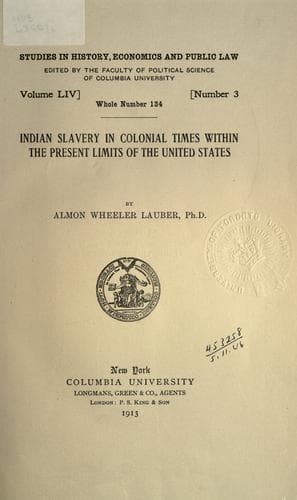
Indian slavery in colonial times within the present limits of the United StatesLauber, Almon Wheeler
History
Indian slavery in colonial times within the present limits of the United States
Lauber, Almon Wheeler
Indians of North America; Indians, Treatment of -- United States; Slavery -- United States; Thesis (Ph. D.)
of 1748 again made slaves personal estate, but was repealed by the
king, October 31, 1751.[821] By the acts of 1779 and 1781 slaves were
still liable to a poll tax of £5 and 10s. respectively, to be paid
by the owner.[822] So it may be seen that from 1649 until after the
Revolution Indian servants and slaves either as persons or as property
were used as a basis for taxation in Virginia.
Massachusetts was the only other colony that assigned the double
status of personalty and real property to its slaves. There, as in
Virginia, the status varied from time to time. Under the earliest laws
of taxation in that colony, slaves must have been rated, if taxed
at all, as polls, the owners paying for them as for other servants
and children, “such as take not wages”. This continued until 1692,
when “every male slave of sixteen years old and upwards” was rated
at “£20 estate”.[823] But in 1694 “all negroes, mulattoes and Indian
servants, as well male as female, of sixteen years old and upwards”,
were assigned a status of personalty by being rated at 12d. per poll,
the same as other polls.[824] In 1695, “all negro, mulatto and Indian
servants” again became a property basis for taxation by an act valuing
negro, mulatto and Indian male servants fourteen years of age and
upward at £20 estate, and similar female servants at £14 estate, unless
disabled by infirmity.[825] They were subsequently, in 1696,[826] rated
as “other personal estate”, which rating was continued in 1697[827]
and 1698,[828] in the latter year “according to the found judgment and
discretion of the assessors, not excluding faculties”, i. e., trades or
professions. This rating for faculties was common throughout the early
tax laws of Massachusetts, and continued into the nineteenth century.
It was applied to white men from the beginning,[829] but the law of
1698 appears to have been the first and only one in which the feature
was applied to the negroes, mulattoes and Indians who were slaves.
There was little variation in the tax laws during the remainder of
the colonial period. All Indian, negro and mulatto servants continued
to be rated as personal property in the usual yearly levies.[830]
Occasionally, as in the earlier period, some of those who were servants
for a term of years, but not for life, were numbered and rated as
polls.[831] Other exemptions were made in the case of slaves “disabled
by infirmity”.[832]
Public-domain text, read in full here on John Shaqi.
Reviews
Reviews
No reviews yet
Be the first to share your thoughts on this work.
Elsewhere in the archive
Join the Discussion
Join the discussion
Sign in to leave a comment or review.
Sign InorCreate an account