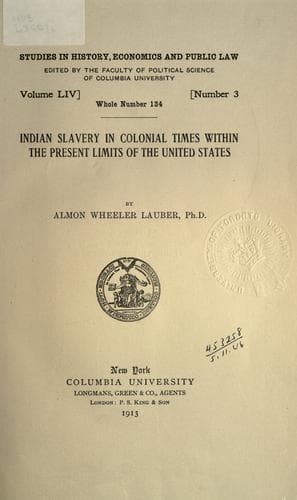
Indian slavery in colonial times within the present limits of the United StatesLauber, Almon Wheeler
History
Indian slavery in colonial times within the present limits of the United States
Lauber, Almon Wheeler
Indians of North America; Indians, Treatment of -- United States; Slavery -- United States; Thesis (Ph. D.)
In 1716, an attempt was made to modify this feature of property status
for slaves in Massachusetts. In that year Judge Sewall was a member of
the council, and on June 22, 1716, proposed to that body that negro
and Indian slaves be no longer rated with horses and hogs as personal
property. The council agreed to the proposition, and its decision
was sent down to the deputies for concurrence. But the members of
the house refused assent on the ground that they were just going to
make a new valuation. In the preceding valuations of the property of
their constituents, Indian, negro and mulatto slaves were regarded as
property, and the owners of it should be taxed accordingly.[833]
In the remaining colonies that taxed Indian and other slaves, such
taxation was levied on the basis of property, sometimes personal and
sometimes real. The annual tax in South Carolina included slaves among
the taxable property.[834] A law of 1719 provided that since Indian
slaves were commonly reputed to be of less value than negro slaves, all
persons possessing them should pay for each Indian in proportion to
half the value of whatever might be rated and imposed for each negro,
and no more.[835]
In New York Indian and negro slaves entered but little into the system
of taxation, since slaves were not numerous in the colony and therefore
would furnish but a poor basis for taxation, and the finances of the
colony were provided for more largely by income taxes than otherwise.
In 1709, however, along with a tax on chimneys, fireplaces and stoves,
a tax of two shillings was levied on every negro or Indian slave from
fifteen to sixty years of age, with directions for collecting the same,
and provision for fine and punishment if such tax were not paid.[836]
Again, in 1734, when arrangement was made to raise a certain amount
yearly for a period of ten years, one source of revenue was to be a
tax of “two pennyweight and twelve grains of Sivil Pillar or Mexican
Plate, or the sum of one shilling in Bills of Credit made current in
this colony” on every Indian or mulatto slave who was above the age of
fourteen and under the age of fifty years.[837]
An instance of Indian slaves serving as a basis of taxation in a local
levy is found in the history of Rye, New York. At a town meeting in
1703, to raise the assessment for the ensuing year, it was decided that
a portion of the sum should be obtained by the tax on £12 valuation of
all slaves of sixteen years old and upward.[838] Though Indian slaves
were not mentioned in the town action, they were doubtless included by
implication, for in 1711 the people of the town were called upon to pay
taxes under “an act for raising one shilling on every Indian and negro
slave.”[839]
Public-domain text, read in full here on John Shaqi.
Reviews
Reviews
No reviews yet
Be the first to share your thoughts on this work.
Elsewhere in the archive
Join the Discussion
Join the discussion
Sign in to leave a comment or review.
Sign InorCreate an account