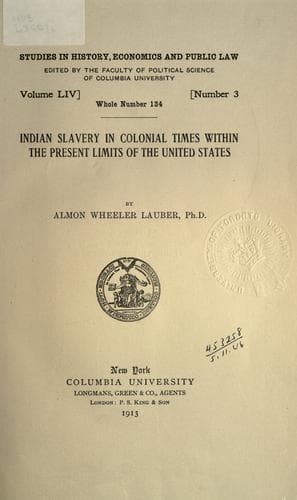
Indian slavery in colonial times within the present limits of the United StatesLauber, Almon Wheeler
History
Indian slavery in colonial times within the present limits of the United States
Lauber, Almon Wheeler
Indians of North America; Indians, Treatment of -- United States; Slavery -- United States; Thesis (Ph. D.)
Indian slaves were made a source of income to their owners by hiring
them out to work in the same way as negroes and indentured white
servants. The colonial laws in some instances made provision for
such use. A South Carolina law of 1712 permitted an owner to hire
out his slaves by the year or for a shorter time, and receive their
earnings.[901] The provision was repeated in acts of 1735[902] and
1740.[903] Maryland, in 1753, provided that masters of ships might hire
servants or slaves from their owners.[904] New York City, in 1731, made
provision for owners hiring out negro and Indian slaves.[905] Since the
custom was common in its application to other servile classes, one may
believe that it was followed in other colonies besides those which made
legal provision regarding it.
The use of Indian slaves in military operations was not infrequent.
In the New England wars Captain Church employed Indian captives
against the enemy, a plan which he found serviceable on several
occasions.[906] This use of Indian as well as negro slaves for military
purposes was advocated in 1666 in a narrative addressed to the Duke of
Albemarle.[907]
In the intercolonial wars both negro and Indian slaves were captured
by the French from the English army. In French records dealing with
occurrences in Canada, under date of November 11, 1747, “four negroes
and a Panis who were captured from the English during the war ...” are
mentioned.[908] Still another possible proof of the use of Indian
slaves by the English army is found in the Articles of Peace drawn up
at Niagara, July 18, 1764. They contain the following: “Article 2nd.
That any English who may be prisoners or deserters, and any negroes,
Panis, or other slaves who are British property, shall be delivered
up within a month to the commandant of Detroit, and that the Hurons
use all possible endeavors to get those who are in the hands of the
neighboring nations, engaging never to entertain any deserters,
fugitives or slaves, but should any fly to them for protection, they
are to deliver them up to the next commanding officer.”[909]
That such slaves were put to practical use in the military preparations
of the colonies, is seen in the New York City ordinances of 1693 and
1694 which provided that all persons, and all negro and Indian slaves
that were not listed, should work on the fortifications.[910] Such
a town action was not unusual. In 1638, the townsmen of Hartford,
Connecticut, voted to levy on the cattle and slaves of the townspeople
when needed for public service.[911]
Public-domain text, read in full here on John Shaqi.
Reviews
Reviews
No reviews yet
Be the first to share your thoughts on this work.
Elsewhere in the archive
Join the Discussion
Join the discussion
Sign in to leave a comment or review.
Sign InorCreate an account