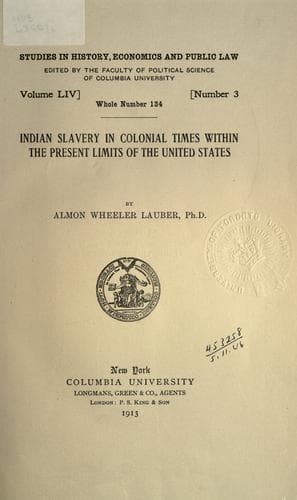
Indian slavery in colonial times within the present limits of the United StatesLauber, Almon Wheeler
History
Indian slavery in colonial times within the present limits of the United States
Lauber, Almon Wheeler
Indians of North America; Indians, Treatment of -- United States; Slavery -- United States; Thesis (Ph. D.)
South Carolina on different occasions offered inducements for slaves to
serve in the war. Some of these acts mentioned Indian slaves. In 1704,
an act was passed “for raising and enlisting such slaves as shall be
thought serviceable to this province in time of alarms”. It provided
for making a list of all negro, mulatto and Indian slaves in the
province fit for service. The masters of the slaves were to be notified
of such listing and given a chance to show cause why it should not be
done. In case the slaves were called upon for service, the master must
furnish weapons according to specifications. If the slave were maimed
or killed in the service, the owner should be compensated out of the
public treasury.[912]
To provide still further for the use of slaves in war, it was decreed
by a South Carolina act of 1719 that the captains, lieutenants, and
ensigns of the militia companies should form a list of negro, mulatto,
mustee and Indian slaves from sixteen to sixty years of age fit for
military service. Owners were given a chance to show why such slaves
should not serve. These slaves when enlisted were to be armed and
equipped by the captain of the division, or they might be armed by
their owners, the latter to be compensated for loss or damage to their
arms. A fine of £20 was fixed for neglect of any owner to send his
slave in time of alarm to the usual place of rendezvous of the various
divisions. Any officer neglecting to carry out the terms of the act was
to be fined £5. A slave serving in war was to be allowed £10 reward if,
on the testimony of a white person, he could prove that he had killed
one of the enemy in time of invasion. The owner was to be indemnified
from the public funds for a slave killed or wounded.[913]
In 1778, when Washington proposed to enlist slaves in the battalions
raised by the State of Rhode Island, the assembly voted that every able
bodied negro, mulatto or Indian man slave in the state might enlist in
either battalion to serve during the continuance of the war. Such slave
was to receive all the bounties, wages and encouragements allowed by
the Continental Congress to any soldier enlisting in the service, and
in addition was immediately to be set free.[914]
It is noticeable that in this legislation regarding the use of slaves
in war, no provision was made for their military training. Such
training would require too much time, and besides being a loss to
the owners, might prove dangerous to the colony if the slaves were
sufficiently numerous. Maryland recognized this fact and in 1715 voted
to exclude slaves from such training.[915]
Public-domain text, read in full here on John Shaqi.
Reviews
Reviews
No reviews yet
Be the first to share your thoughts on this work.
Elsewhere in the archive
Join the Discussion
Join the discussion
Sign in to leave a comment or review.
Sign InorCreate an account