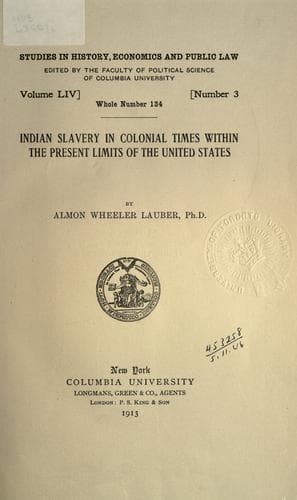
Indian slavery in colonial times within the present limits of the United StatesLauber, Almon Wheeler
History
Indian slavery in colonial times within the present limits of the United States
Lauber, Almon Wheeler
Indians of North America; Indians, Treatment of -- United States; Slavery -- United States; Thesis (Ph. D.)
Just as the Spanish and the French made diplomatic and military use
of their Indian slaves by returning them to their own tribes and
thus winning friendship and peace, so the English followed the same
practice. In 1715, in order to secure the aid of the Tuscarora, the
assembly of South Carolina voted that, for every one of these allies
killed in actual warfare by the enemy, a Tuscarora slave then in
servitude among the whites should be given them for the loss, and that
to every Tuscarora taking an Indian enemy captive, a slave of his
nation should similarly be assigned as a reward.[916]
CHAPTER XI
+Treatment+
The treatment of Indian slaves apparently differed in no essential
degree from that of the negroes. The slaves of the two races lived
and worked together; but since the negroes were in the majority, the
treatment of slaves in general was determined by the ordinary usage
which the whites accorded them in particular. It is customary for
writers dealing with early slavery among both the English and French
of America to declare it mild in nature.[917] The statement appears to
be true. The system was patriarchal in nature, though it is doubtful
if race feeling among the English was ever so nearly obliterated,
and a condition of fellowship approaching equality ever so fully
developed, as in the case of the French. Individual cases of cruelty
and harsh treatment undoubtedly existed as they must exist in all
cases of servitude; but Indian slavery never became an institution
sufficiently well organized to make harsh treatment general. There was
never anything in either the English or French colonies corresponding
to the labor gang used by the Spanish. The number of Indian slaves
in a locality was too small for that; nor did the service which the
colonists required of their Indian slaves demand it. Kind treatment,
however, did not exclude the infliction of corporal punishment, if
thought needful.[918]
Public-domain text, read in full here on John Shaqi.
Reviews
Reviews
No reviews yet
Be the first to share your thoughts on this work.
Elsewhere in the archive
Join the Discussion
Join the discussion
Sign in to leave a comment or review.
Sign InorCreate an account