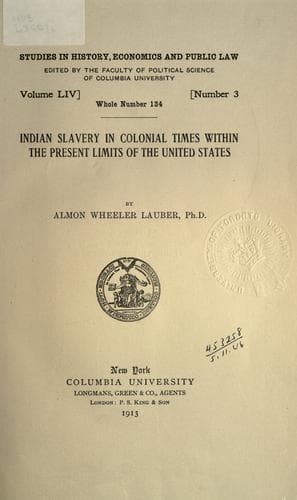
Indian slavery in colonial times within the present limits of the United StatesLauber, Almon Wheeler
History
Indian slavery in colonial times within the present limits of the United States
Lauber, Almon Wheeler
Indians of North America; Indians, Treatment of -- United States; Slavery -- United States; Thesis (Ph. D.)
To judge from the frequent newspaper advertisements of runaways, the
Indian slaves of the English colonists were at least comfortably
dressed. The following are typical extracts from the newspapers of the
various colonies: “a black crape gown and a striped stuff jacket”;
“a blue flannel petticoat, a dark Estamine gown and a double striped
gown”;[919] “a grey coat with pewter buttons, with leather breeches,
an old tow shirt, grey stockings, good shoes and felt hat”;[920] “a
green hat and yellow breeches”;[921] “an orange colored broadcloth
coat, with a narrow cape, and a flannel jacket with narrow stripes, a
cotton shirt, and a loose pair of Oxenbridge trousers ... a beaver hat,
and had a bundle of clothes with him”;[922] “an old blue coat, striped
flannel jacket, pretty good hat, black wig, linen trousers, white yarn
stockings, and an old pair of mended shoes”;[923] “a good felt hat,
orange colored jacket, thick leather breeches, checked wool shirt,
light grey stockings and pretty good shoes”:[924] “pea-jacket of light
brown, leather breeches, shoes, stockings and hat”;[925] “a drugat
waistcoat and kersey petticoat of a light color”.[926] From these
advertisements it appears that the slaves were dressed much like the
colonists themselves, though doubtless their clothing often consisted
of “cast offs”. In the Carolinas where slaves were more numerous,
coarse goods were imported by the planters for slaves’ clothing.
Mention is found of “serge suits for the servant maids, of coarse
kerseys, tufted holland jackets, etc.”, with which the plantation was
wont to be supplied for the slaves and convict servants. These were
used in addition to cloth woven and made into clothes by the women of
the household.[927]
Generally kind as the treatment of Indian slaves may have been,
the sentiment of the English colonists was quite opposed to the
intermingling of whites and Indians, bond or free, even if in the
early history of Virginia there was some effort made to encourage the
marriage of whites and free Indians.[928] It was natural, therefore,
that definite action should be taken to prevent the marriage of free
whites and Indian slaves. In 1691, Virginia passed an act forbidding
the union of free whites with Indians whether slave or free; but
there seems to have been no provision against marriage of negroes or
Indians with white indentured servants.[929] The provision, perhaps,
was unnecessary, for the consent of the white indentured servant’s
master was necessary for the validity of such a union, and such consent
was usually refused because of the strong prejudice against race
mixture.[930]
Public-domain text, read in full here on John Shaqi.
Reviews
Reviews
No reviews yet
Be the first to share your thoughts on this work.
Elsewhere in the archive
Join the Discussion
Join the discussion
Sign in to leave a comment or review.
Sign InorCreate an account