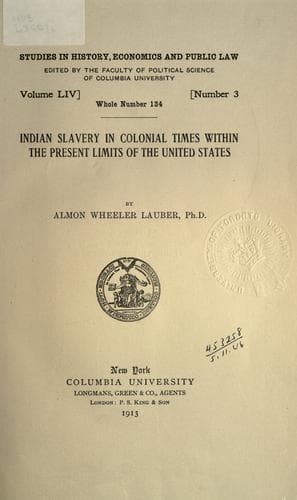
Indian slavery in colonial times within the present limits of the United StatesLauber, Almon Wheeler
History
Indian slavery in colonial times within the present limits of the United States
Lauber, Almon Wheeler
Indians of North America; Indians, Treatment of -- United States; Slavery -- United States; Thesis (Ph. D.)
North Carolina, also, in 1715, passed an act forbidding the marriage
of whites with negroes, mulattoes or Indians, under penalty of £50,
and making clergymen celebrating such a marriage liable to a fine of
£50.[931] A later act of 1741 provided a fine of £50 for the marriage
of any white man or woman with an Indian, negro, mustee, mulatto,
or any person of mixed blood to the third generation, bond or free.
Any minister or justice of the peace performing such a service was
punishable by a fine of £50.[932] Maryland, on its own part, in 1692,
passed an act against the marriage or promiscuous sexual relations
of whites and negroes or other slaves. Any white person so offending
was to become a servant for seven years, if free at the time of the
marriage. If already a servant, he or she must serve seven years after
the end of the present term of service.[933]
The same feeling existed in New England. A Massachusetts act of 1692
forbade the marriage, under severe penalty, of any white person with
a negro, Indian or mulatto. Mixed marriages of whites and Indians,
like those admired by Sewall in 1702,[934] did occur, however, in New
England,[935] and it appears probable that some of these marriages were
with the enslaved captives of King Philip’s War and the Indian slaves
imported from Carolina.
Considering, further, the determination of legal relations between the
whites and the Indian slaves, it should be remembered that, when not
specifically referred to, Indian slaves were included by implication
in the legislative acts of the various colonies relating to slaves.
Sufficient proof of this statement lies in the fact that Indian slaves
are directly mentioned in certain of the legislative acts of any given
colony, whereas other acts of the same colony specify slaves, negroes
and other slaves, or negro and mulatto slaves.[936] In one colony,
Virginia, the term “mulatto” was made to include Indians by the act of
1705, which provided that the child of an Indian should be “deemed,
accounted, held and taken to be a mulatto.”[937]
Public-domain text, read in full here on John Shaqi.
Reviews
Reviews
No reviews yet
Be the first to share your thoughts on this work.
Elsewhere in the archive
Join the Discussion
Join the discussion
Sign in to leave a comment or review.
Sign InorCreate an account