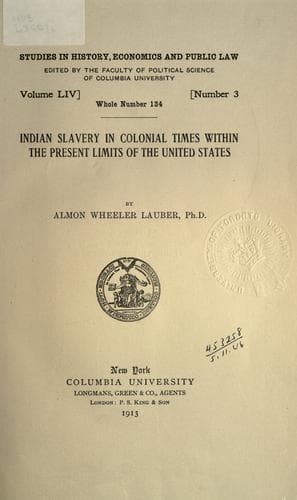
Indian slavery in colonial times within the present limits of the United StatesLauber, Almon Wheeler
History
Indian slavery in colonial times within the present limits of the United States
Lauber, Almon Wheeler
Indians of North America; Indians, Treatment of -- United States; Slavery -- United States; Thesis (Ph. D.)
It was a part of the universal law of slavery in the southern colonies
that a slave should not be allowed to testify against a white person in
the courts.[938] South Carolina, by the acts of 1712,[939] 1722[940]
and 1735,[941] permitted “negroes and other slaves” to testify in the
trial of any slave accused of specified crimes and offenses. Certain
of the colonies, by express provision, forbade Indian slaves to
give testimony in the trial of whites. North Carolina declared that
“all negroes, mulattoes, bond and free to the third generation, and
Indian servants and slaves, shall be deemed to be taken as persons
incapable in law to be witnesses in any case whatever except against
each other”.[942] Virginia, 1705, decreed that “popish recusants,
convict negroes, mulattoes and Indian servants and others not being
Christians, shall be deemed and taken to be persons incapable in
law to be witnesses in any case whatsoever”.[943] In 1732, the same
colony decreed that the evidence of any negro or Indian slave might
be received in the trial of any slave, but was not valid in the trial
of any other person.[944] Maryland declared, in 1717, that it would
be dangerous to allow the evidence of any negro, mulatto or Indian
slave in the trial of a freeman, but conceded that, if evidence was
lacking in cases regarding any negro, mulatto or Indian slaves, that
such slaves might give testimony for or against themselves and one
another.[945] In some of the northern colonies, at least, acts were
passed forbidding slaves to give testimony in the trial of white
persons. The New York law of 1706 is a case in point.[946] This feature
of the law of evidence was renewed from time to time in the various
colonies and continued until the Revolution.
Public-domain text, read in full here on John Shaqi.
Reviews
Reviews
No reviews yet
Be the first to share your thoughts on this work.
Elsewhere in the archive
Join the Discussion
Join the discussion
Sign in to leave a comment or review.
Sign InorCreate an account