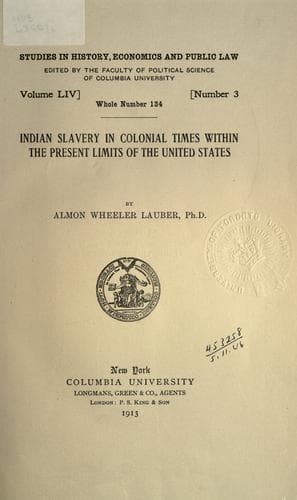
Indian slavery in colonial times within the present limits of the United StatesLauber, Almon Wheeler
History
Indian slavery in colonial times within the present limits of the United States
Lauber, Almon Wheeler
Indians of North America; Indians, Treatment of -- United States; Slavery -- United States; Thesis (Ph. D.)
The right to life was generally conceded all slaves regardless of
color. At least one colony, New Hampshire, 1708, in an act guaranteeing
this right, included Indian slaves by specific mention.[947] This
and other rights could be protected by appeal to the courts. If not
otherwise provided for, the mode of trial used by the colonists
themselves was employed in the case of Indian slaves, negroes and free
Indians.[948] Special legislation concerning the trial of slaves was
enacted by all the English colonies. It has been said that for an
Indian to gain his point in an English court, unless his case was an
extremely strong one, was a rare occurrence.[949] Whether the statement
is generally true in the case of either free or slave Indians, might
be difficult to decide. Doubtless the Indian slave supported by his
master possessed a better chance of obtaining justice than the free
Indian. Since a slave was owned body and soul, and therefore had no
right to life except as the same might be conceded by his owner and
the authorities, it may be said that whatever legal rights he had were
granted for the protection of the slave owners in their property rights
and for the general safety of the community, rather than because of any
special consideration of justice toward the slave himself.
Virginia, in 1692, provided special courts for the trial of
slaves.[950] The provisions regarding these courts were changed from
time to time. By the act of 1765 it was provided that the justices be
given a standing commission of oyer and terminer empowering them to
try without a jury all criminal offenses committed by slaves in their
respective counties.[951] In accordance with these provisions one finds
the Earl of Dunmore issuing a commission in 1772 to certain justices in
the county of the present state of West Virginia, authorizing them to
serve as a court for the trial of negro and Indian slaves.[952]
The Massachusetts general court provided, 1647, that one or more of the
magistrates, according to agreement among themselves, should hold a
court every quarter to hear and determine all cases civil and criminal,
except those involving capital punishment, which might concern Indians,
and that minor offenses should be tried by the sachems themselves.[953]
At the first general court held on Martha’s Vineyard, June 18, 1672, it
was ordered that an Indian should have liberty in any case to appeal
from such courts as they held among themselves to the quarter court,
and from the quarter court to the general court.[954]
A New Jersey act of 1713 provided for the trial of any negro, Indian or
mulatto slave accused of committing murder, rape, etc., by a justice
and five freeholders. But if the owner of such slave should desire a
jury, the privilege might be allowed him. He also had the right to
challenge jurors as in other cases of like nature.[955] The act was
repealed in 1768.[956]
Public-domain text, read in full here on John Shaqi.
Reviews
Reviews
No reviews yet
Be the first to share your thoughts on this work.
Elsewhere in the archive
Join the Discussion
Join the discussion
Sign in to leave a comment or review.
Sign InorCreate an account