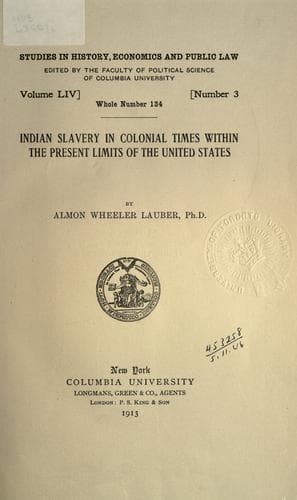
Indian slavery in colonial times within the present limits of the United StatesLauber, Almon Wheeler
History
Indian slavery in colonial times within the present limits of the United States
Lauber, Almon Wheeler
Indians of North America; Indians, Treatment of -- United States; Slavery -- United States; Thesis (Ph. D.)
By a New York act of 1712, three justices and five freeholders of the
county constituted judge and jury, seven making a quorum, for the
trial of negro and Indian slaves accused of murder, rape, insurrection
or conspiracy. The prosecution provided the accusation to which the
offended was obliged to plead apparently without the aid of counsel.
The owner of the slave was given the right, however, to have his slave
tried by a jury of twelve, provided he paid the jury charges of nine
shillings.[957] An act of 1730 changed the required number of justices
to three, one to be a quorum, associated with five of the principal
freeholders of the county. Agreement of seven was required for the
decision. In this case, as before, the owner could have his slave tried
by a jury of twelve if he paid the jury charges of nine shillings.[958]
There was a general tendency among slave owners to conceal crimes
committed by slaves, or to secrete slave offenders and thus avoid the
financial loss consequent upon the time consumed by the trial and the
possible imprisonment of the slave in case of conviction, as well as
the possible injury to the slave by corporal punishment, or the still
greater loss of the slave’s entire value in case of his execution.
To prevent this interference with justice, as well as to recognize
and protect the property rights of the slave owners, special acts
were passed in some of the colonies providing that the slave owner be
remunerated by the colonial government in case of the loss of his slave
through execution for crime. In some colonies the amount to be paid the
owner of a slave was specified by law, and this amount varied from £30
for a man slave, and £20 for a woman slave (negro, Indian or mulatto),
as provided for in a New Jersey act of 1713,[959] to £50 in a South
Carolina act of 1717.[960] In other colonies the amount to be paid the
slave owner was left to the decision of the court. The Maryland act of
1717[961] is a case in point. It provided that the court should value
the slave (negro, mulatto or Indian) in tobacco, and that three-fourths
of the value thus adjudged should be allowed in the public levy to be
paid to the owner of the slave.
Public-domain text, read in full here on John Shaqi.
Reviews
Reviews
No reviews yet
Be the first to share your thoughts on this work.
Elsewhere in the archive
Join the Discussion
Join the discussion
Sign in to leave a comment or review.
Sign InorCreate an account