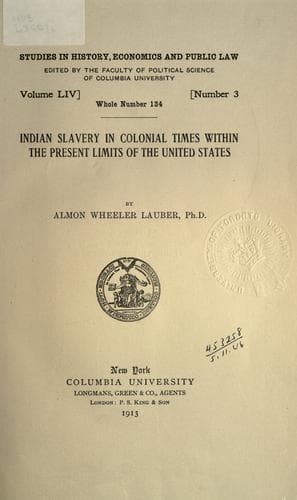
Indian slavery in colonial times within the present limits of the United StatesLauber, Almon Wheeler
History
Indian slavery in colonial times within the present limits of the United States
Lauber, Almon Wheeler
Indians of North America; Indians, Treatment of -- United States; Slavery -- United States; Thesis (Ph. D.)
In all of the colonies the conduct of Indian slaves as well as that
of other slaves was necessarily subject to police regulations, and
punishments were decreed for their violation. These regulations did
not differ greatly in the various colonies, for the problems arising
from the use of slaves varied but little in their nature. Among the
prohibitions laid on Indian slaves specifically were the following: to
be away from home without the owner’s permission;[962] the possession
of fire arms;[963] and engaging in certain kinds of traffic.[964]
Boston decreed, 1728, that no Indian, negro or mulatto should carry
stick or cane within the town.[965] In 1778, when forming its first
proposed constitution, Massachusetts excepted from the franchise
“negroes, Indians and mulattoes, bound and free”.[966] In an act of
1660 the Connecticut general court declared that neither negro nor
Indian servants should be required to “train, watch or ward”.[967]
In 1676, New York City excluded all Indian and negro slaves from
the privilege of being carters, and in the same year passed an act
to prevent the revels of Indian and negro slaves at inns.[968] An
ordinance of the Albany city council, 1686, forbade any negro or Indian
slave to drive a cart within the city.[969] A New York act of 1731,
also, provided for regulating the conduct of negroes and Indians in the
night time.[970]
Few of the acts of colonial legislatures decreeing punishment for
various offenses mention Indian slaves; yet in the following colonies
the death penalty was to be inflicted upon Indian slaves convicted
of certain crimes:[971] by North Carolina, in 1741, for the second
offense of killing horses, cattle or hogs, and for stealing, mismarking
or misbranding such animals;[972] by New Jersey, in 1713, for murder,
or conspiracy, or attempt to murder,[973] and in 1768, for rape, for
wilfully burning any dwelling-house, barn, stable, outhouse, stacks
of corn or hay, for wilfully mutilating, maiming or dismembering any
person, for manslaughter, for stealing any sum of money above the value
of £5, and for committing any felony or burglary.[974]
Branding as a punishments for Indian slaves was decreed by the
Massachusetts general court. Runaway Pequot slaves were so
punished.[975] Judging from the descriptions of runaway Indian slaves
contained in the colonial newspapers, some form of branding or marking
such culprits was used until a late period. These brands or marks
sometimes took the form of letters or symbols pricked into the skin by
gunpowder or India ink. They were placed usually on the forehead or the
cheeks.[976]
Public-domain text, read in full here on John Shaqi.
Reviews
Reviews
No reviews yet
Be the first to share your thoughts on this work.
Elsewhere in the archive
Join the Discussion
Join the discussion
Sign in to leave a comment or review.
Sign InorCreate an account