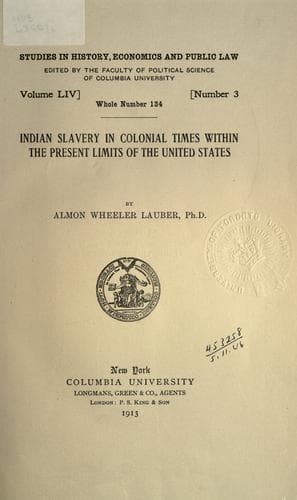
Indian slavery in colonial times within the present limits of the United StatesLauber, Almon Wheeler
History
Indian slavery in colonial times within the present limits of the United States
Lauber, Almon Wheeler
Indians of North America; Indians, Treatment of -- United States; Slavery -- United States; Thesis (Ph. D.)
Whipping, the most common punishment provided by law for Indian as well
as other slaves, was decreed by different colonies as follows: by North
Carolina, in 1741, to consist of thirty-nine lashes well laid on, for
giving false testimony in court, killing any domestic animal without
the owner’s consent, and for stealing, mismarking or misbranding such
animals;[977] by Pennsylvania, in 1721, for making, selling or using
any fireworks or firearms in Philadelphia,[978] and in 1751, for taking
part in horse races or shooting matches without a license, fifteen
lashes for the first offense and twenty-one for the second;[979] by New
Jersey, in 1713, for stealing to the value of six pence;[980] by New
York City, in 1682, for absence from their owners’ homes or plantations
without ticket of leave in owners’ handwriting,[981] in 1683, ten
lashes for meeting together at any place on Sunday or any other day in
groups of more than four, and possessing arms, unless the owner paid
six shillings in lieu of the penalty,[982] in 1713[983] and 1731,[984]
thirty-nine lashes for being found in the city streets, if above the
age of fourteen years, later than one hour after sunset, in 1721,[985]
and 1731,[986] for gambling, in 1731, for attending a funeral in
groups of more than twelve,[987] for disorderly riding through the
streets,[988] and for selling “the Fish Commonly Called and known by
the name of Bass” in the months of December, January and February,[989]
and in 1759, for committing any nuisance in the streets;[990] by
Connecticut, in 1750, forty lashes for publishing or speaking such
words of and concerning any other person, which, if spoken or published
by a white person, would be considered by law objectionable,[991]
and for being abroad after nine o’clock at night;[992] and by
Massachusetts, in 1693, for dealing in stolen goods.[993] The town of
Medford, Massachusetts, ordered, in 1734, that all negro, Indian or
mulatto slaves found abroad without leave and not on their masters’
business were to be punished by whipping.[994] Block Island, finally,
in 1709, provided ten lashes as punishment for any negro or Indian
slave abroad after nine o’clock at night.[995]
Punishment by mutilation was sometimes used, especially in the southern
colonies.[996] North Carolina, in 1741, provided that any slave,
negro or Indian, giving false testimony in any court was to have an
ear nailed to the pillory and to stand there for an hour, after which
the ear was to be cut off. The other ear was then to be nailed in like
manner and cut off at the expiration of an hour. By the same act the
cutting off of both ears was made a partial punishment for killing
horses, cattle or hogs without the consent of the owner, and for
stealing, misbranding or mismarking such animals.[997]
Public-domain text, read in full here on John Shaqi.
Reviews
Reviews
No reviews yet
Be the first to share your thoughts on this work.
Elsewhere in the archive
Join the Discussion
Join the discussion
Sign in to leave a comment or review.
Sign InorCreate an account