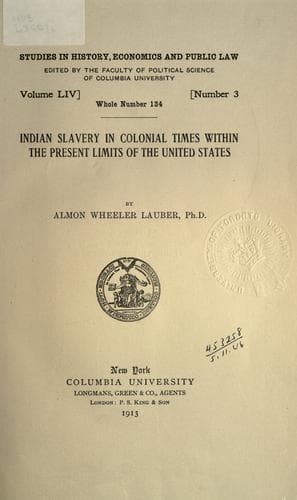
Indian slavery in colonial times within the present limits of the United StatesLauber, Almon Wheeler
History
Indian slavery in colonial times within the present limits of the United States
Lauber, Almon Wheeler
Indians of North America; Indians, Treatment of -- United States; Slavery -- United States; Thesis (Ph. D.)
Certain of the colonies attempted to prevent the sale of spirituous
liquors to Indian and other slaves. At the time of King Philip’s War,
Massachusetts forbade the sale of liquor without license to any Indian
or negro.[998] New Hampshire, 1686, passed a similar act.[999] In the
same year the common council of Albany prohibited the selling of liquor
to Indian slaves without the owners’ permission.[1000]
Considering still another phase of treatment, namely, that which had
to do with religious instruction, it may be said that, among the early
regulations of the British government for the colonies, it was required
that measures be taken whereby “slaves may be best invited to the
Christian faith and be made capable of being baptized therein”.[1001]
In the instructions to the colonial governors the home government not
infrequently gave directions for the conversion of both negroes and
Indians, but the Indians referred to were free, not slave. The enslaved
natives were in too great a minority to attract attention; but any
effort to instruct and convert the negroes must, of course, include
the former by implication.[1002]
The good intentions of the home government for the conversion of
slaves were commonly frustrated by the popular belief that baptism
conferred freedom upon slaves. The general attitude of slave owners
in all the colonies was to oppose or forbid the religious instruction
and conversion of negro and Indian slaves. They argued that the
instruction and conversion of slaves tended to make them disrespectful
and unreliable and hence decreased their value. Consequently the
religious training of slaves in the earlier colonial period depended
upon the personal teaching of the owner’s family.[1003] This condition
of affairs appealed strongly to the missionaries of the Society for
the Propagation of the Gospel in Foreign Parts[1004] on their coming
to America primarily to work among the Indian tribes. In the reports
sent to their Society early in the eighteenth century they lamented the
unenlightened condition of the slaves, and urged that they be allowed
to work among them where they believed their efforts would accomplish
more than among the Indian tribes. The Society granted their requests
and gave them special instructions to look after the spiritual
interests of all slaves.[1005] Their subsequent reports, though they
dealt primarily with negro slaves, sometimes made mention of Indian
slaves, and show that there was no distinction in religious matters
between the slaves of the two races.
Public-domain text, read in full here on John Shaqi.
Reviews
Reviews
No reviews yet
Be the first to share your thoughts on this work.
Elsewhere in the archive
Join the Discussion
Join the discussion
Sign in to leave a comment or review.
Sign InorCreate an account