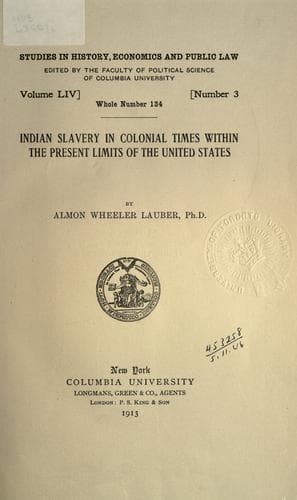
Indian slavery in colonial times within the present limits of the United StatesLauber, Almon Wheeler
History
Indian slavery in colonial times within the present limits of the United States
Lauber, Almon Wheeler
Indians of North America; Indians, Treatment of -- United States; Slavery -- United States; Thesis (Ph. D.)
A letter from Samuel Thomas to the Society, December 21, 1705, told
of the employment of negro and Indian slaves on the Lord’s Day;[1006]
but in a memorial of the same year he rejoiced in the prospect of
bringing many Indian and negro slaves to the knowledge and practice
of Christianity.[1007] In a letter of the following year he urged
that the Society give the missionaries strict charge to labor with
great diligence in the conversion of the Indian and negro slaves
in the respective parishes.[1008] In 1710, he reported that there
was several unconverted Apalachee slaves in his parish whom he was
especially anxious to baptize.[1009] Le Jau, another missionary in
South Carolina, reported, in 1708, that the masters opposed the baptism
and marriage of their slaves, and declared that “many masters cannot be
persuaded that negroes and Indians are otherwise than beasts and use
them like such”.[1010] In the same year he reported many Indian and
negro slaves instructed and on probation for baptism.[1011] In 1710,
also, certain masters had so far yielded in their opposition to the
religious training of slaves as to allow Indian and negro slaves to
remain a half-hour after the services for instruction.[1012] In 1711,
one Indian slave and thirty negro slaves had joined the church in his
parish,[1013] and he was catechizing “negroes and other slaves” with
their masters’ consent,[1014] though then, and even at a later period,
other masters in the same parish (Goose Creek) opposed his work among
the slaves.[1015] Where such consent was granted, the slaves were often
required to declare that they were not being baptized out of any effort
to free themselves.[1016] From still another South Carolina parish (St.
Thomas) the pastor, Haskell, wrote in 1711 that he was encouraging the
conversion of Indian and negro slaves, and that he was also trying to
persuade their masters to his mind.[1017] He met with some success, for
another letter of the same year recorded the baptism of two negroes
and an Indian slave.[1018] As late as 1730, however, he reported that
the religious instruction of Indian and negro slaves was obstructed
by irreligious and worldly people.[1019] In 1707, Dunn, the pastor
of a parish thirty miles from Charleston reported that he met great
difficulty in persuading masters to allow their Indian and negro slaves
to receive religious instruction or to be baptized, since they believed
that baptism would free slaves.[1020]
Public-domain text, read in full here on John Shaqi.
Reviews
Reviews
No reviews yet
Be the first to share your thoughts on this work.
Elsewhere in the archive
Join the Discussion
Join the discussion
Sign in to leave a comment or review.
Sign InorCreate an account