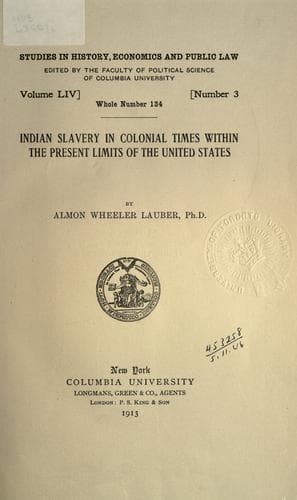
Indian slavery in colonial times within the present limits of the United StatesLauber, Almon Wheeler
History
Indian slavery in colonial times within the present limits of the United States
Lauber, Almon Wheeler
Indians of North America; Indians, Treatment of -- United States; Slavery -- United States; Thesis (Ph. D.)
The same attitude of masters concerning the religious instruction of
their slaves was reported from other colonies by the missionaries of
the Society in question. But since the number of Indian slaves in no
other colony was as large as in South Carolina, the mention of them by
the missionaries is far less frequent, when made at all. Sharpe of New
York, in a letter of 1712, mentioned two Spanish Indian slaves who were
Christians.[1021] Neau of New York reported much opposition of masters
to his work among the slaves.[1022] But Governor Cornbury promised to
help him,[1023] and evidently his labors were successful, for a report
in 1726 alluded to fourteen hundred negro and Indian slaves, many of
whom had been instructed by Neau.[1024]
Since in general the religious instruction of servants and slaves was
recognized as a duty by both the civil and ecclesiastical authorities
in England, the response of the Society for the Propagation of the
Gospel in Foreign Parts to these letters and reports was encouraging,
and the missionaries were directed to do all in their power for the
education and conversion of all slaves.[1025] On one occasion the
Society went so far as to draft a bill to be introduced into Parliament
providing for the more effectual conversion of negroes and servants in
the plantation,[1026] and also petitioned the Archbishop of Canterbury
that his majesty be requested to encourage the passage of laws in
the colonies to the effect that baptism did not confer freedom upon
slaves.[1027]
The colonial clergy similarly tried to obtain legislation at home which
might serve to dispel the popular illusion that baptism conferred
freedom upon slaves. A proposition contained in Mr. Forbes’ account
of the state of the church in Virginia, July 21, 1724, is a case in
point. It stated that the Christian duty of instructing and educating
heathen slaves in the Christian faith was much neglected by slave
owners in America, though recommended by his majesty’s instructions.
It was accordingly proposed that every Indian, negro or mulatto child
that should be baptized and publicly catechized by the minister in
church, and who could, before the fourteenth year of his or her age,
give a distinct account of the creed, the Lord’s Prayer and the ten
commandments, should, if the owner received a certificate from the
minister to that effect, be exempted from paying all levies till the
age of eighteen years.[1028]
Public-domain text, read in full here on John Shaqi.
Reviews
Reviews
No reviews yet
Be the first to share your thoughts on this work.
Elsewhere in the archive
Join the Discussion
Join the discussion
Sign in to leave a comment or review.
Sign InorCreate an account