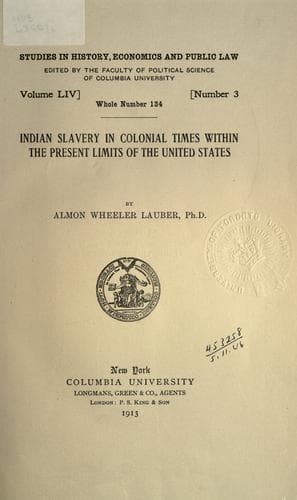
Indian slavery in colonial times within the present limits of the United StatesLauber, Almon Wheeler
History
Indian slavery in colonial times within the present limits of the United States
Lauber, Almon Wheeler
Indians of North America; Indians, Treatment of -- United States; Slavery -- United States; Thesis (Ph. D.)
Laws to this effect were passed in some of the colonies. The Carolina
Fundamental Constitutions of 1669 had provided that it should be
lawful for slaves to become members of any church or religious
profession as if they were freemen, but that every owner should have
absolute power and authority over his slaves regardless of their
opinion or religion.[1029] But by the so-called “Church Act” of 1705
South Carolina showed itself averse to the policy advocated in the
Constitutions of 1669, and decreed that the register of a parish
should except negro and Indian slaves from the entries of births,
christenings, marriages and burials.[1030] The law suited the times
and was accordingly followed.[1031] But in 1712, in order to correct
the popular misconception that a Christianized slave was by law free,
an act was passed to the effect that baptism of slaves did not confer
freedom upon them.[1032]
As early as 1655, the Virginia assembly had voted that Indian servants
should be educated and brought up in the Christian faith.[1033] Yet the
idea that baptism conferred freedom upon a slave even then existed in
the colony, since one of the reasons given for the disallowance of the
sale of an Indian boy by “The Kinge of Waineoke” to Elizabeth Short in
1659 was that the boy was desirous of baptism.[1034] The above action
of the legislature probably contributed to the enactment of the law of
1667 which decreed that the baptism of a slave did not confer freedom
upon him or in any way change his condition. The act naively declared
the reason for this legislative action to be that masters freed from
this doubt might the more carefully encourage the propagation of
Christianity by permitting the conversion of slaves.[1035] The act of
1670, when slaves were for the first time legally designated as such
in Virginia, decreed that freedom resulting from Christianity was
limited to servants imported by shipping. Consequently Indian servants
or slaves, since they generally came into the colony by land, were not
eligible to become freemen by the provision.[1036] The act of 1670 was
repealed in 1682 and a new act removed the possibility of conversion
to Christianity conferring freedom upon any slaves, negro, mulatto or
Indian, by decreeing that whether converted to Christianity before or
after being brought to the colony, they should remain slaves.[1037]
Finally, in 1712, Virginia passed a law requiring that the parents of
free-born children and the owners of slave-born children, within twenty
days after the birth of a child, should give notice in writing of the
birth, with name and sex, the names of the parents of a free-born
child, and the name of the owner of a slave-born child. The death of
a slave was to be reported to the minister of the parish in the same
way, and the minister was required to keep a record of all births and
deaths in his parish.[1038] Virginia parish registers after this date
contain records of the death of Indian slaves.[1039] Maryland, also, by
Public-domain text, read in full here on John Shaqi.
Reviews
Reviews
No reviews yet
Be the first to share your thoughts on this work.
Elsewhere in the archive
Join the Discussion
Join the discussion
Sign in to leave a comment or review.
Sign InorCreate an account