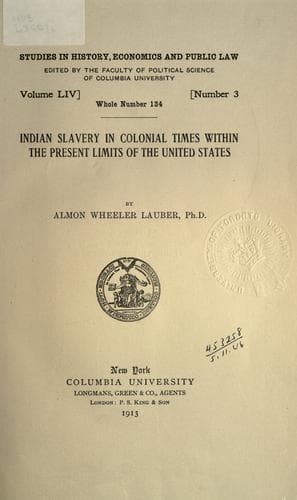
Indian slavery in colonial times within the present limits of the United StatesLauber, Almon Wheeler
History
Indian slavery in colonial times within the present limits of the United States
Lauber, Almon Wheeler
Indians of North America; Indians, Treatment of -- United States; Slavery -- United States; Thesis (Ph. D.)
the acts of 1692,[1040] 1694,[1041] 1704[1042] and 1715[1043] sought
to encourage the baptism of “negroes and other slaves” by asserting
that baptism did not confer freedom upon slaves or their offspring. In
accordance with the instructions of Queen Anne to Governor Cornbury,
1702, New Jersey passed an act in May, 1704, declaring that baptism of
any negro, Indian or mulatto slave should not be considered reason or
cause for his freedom.[1044]
The amended “Duke’s Laws” published about 1674, decreed that turning
Christian should not set at liberty any negro or Indian servant in New
York who had been bought by any person.[1045] Evidently the colonists
put but little faith in this provision, for Governor Dongan reported in
1687 that they “take no care of the conversion of their slaves.”[1046]
The old idea that conversion conferred freedom upon slaves prevailed,
and was doubtless strengthened by an order of the council, October 11,
1687, that Christian Indians and children of Christian parents brought
from Campeachy and Vera Cruz as slaves should be set free,[1047] and
by a similar order in the following year that Spanish Indian slaves
professing Christianity were to be released and sent home.[1048] This
last order was accompanied by a decree of the council, July 30, 1688,
that the Spanish Indian slaves of certain persons be brought before
it with a view of liberating them if they were able to say the Lord’s
Prayer.[1049] A report of Governor Bellomont, April 27, 1699, also,
states that a “Bill for facilitating the conversion of negroes and
Indians ... would not go down with the assembly; they having a notion
that the negroes being converted to Christianity would emancipate
them from their slavery, and loose them from their service.”[1050]
But an act of October 24, 1706, “to encourage the Baptizing of Negro,
Indian and Mulatto slaves” stated that the baptism of slaves did not
confer freedom upon them.[1051] This partially calmed the fears of the
slave owners, and the baptism of slaves became more frequent;[1052]
but it did not lead the owners in all cases to favor the work of the
missionaries among the slaves. In 1724, Mr. Jenney reported to the
Society for the Propagation of the Gospel in Foreign Parts: “There
are a few negroes and Indian slaves ... in my parish: the catechist,
a school-master from the honorable society, has often proposed to
teach them the catechism, but we cannot prevail upon their masters
to spare them from their labor for that good work.”[1053] Again, in
1728, Mr. Wetmore reported the opposition of Quaker, Presbyterian
and Episcopalian masters to the instruction and baptism of their
slaves,[1054] but in 1734 he alluded to the baptism of one adult Indian
slave.[1055]
Public-domain text, read in full here on John Shaqi.
Reviews
Reviews
No reviews yet
Be the first to share your thoughts on this work.
Elsewhere in the archive
Join the Discussion
Join the discussion
Sign in to leave a comment or review.
Sign InorCreate an account