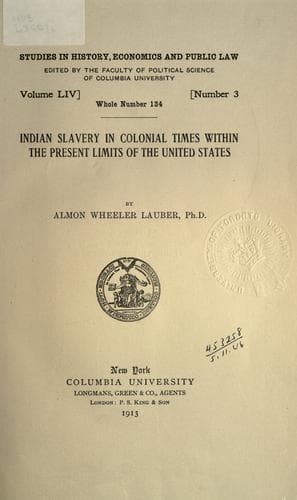
Indian slavery in colonial times within the present limits of the United StatesLauber, Almon Wheeler
History
Indian slavery in colonial times within the present limits of the United States
Lauber, Almon Wheeler
Indians of North America; Indians, Treatment of -- United States; Slavery -- United States; Thesis (Ph. D.)
In New England the earliest action taken by the colonial government
with regard to the religious instruction of slaves occurred in 1677
in connection with the disposal as slaves of the captives taken in
King Philip’s War, when it was decreed that all the Indian slaves
distributed among the inhabitants of the colony should “be taught and
instructed in the Christian religion.”[1056] How far such religious
training was carried out would be difficult to ascertain. Occasional
glimpses of the situation can be obtained. Experience Mayhew lamented
that all the English did not instruct their servants in the “principles
of the true religion”;[1057] though he cited instances when Indian
servants, some of whom may have been slaves, were so instructed.[1058]
Just how much missionary work was done in the homes of Massachusetts
or elsewhere for the conversion of Indian servants and slaves is not
known. Indian slaves were owned by ministers of the gospel, and it
may be supposed that some attention was given to their instruction.
Evidently the religious spirit of the Massachusetts colonists was
sufficiently strong to include Indian slaves and servants, for in
some churches negroes and Indians had a special location assigned
them in the church[1059] and occasional reference is found to Indian
slaves being church members. According to the baptismal records of
November 19, 1727, for example, the Indian slave of Lieutenant Stephen
Longfellow, great-great-grandfather of the poet, was his fellow member
in the Byfield church.[1060] In this same year the Reverend Timothy
Cutler reported from Boston: “Negro and Indian slaves belonging to my
parish are about thirty-two, their education is according to the houses
they belong to. I have baptized but two. But I know of the masters of
some others who are disposed to this important good of their slaves and
are preparing them for it; however, there is too great a remissness
upon this article”.[1061] In Rhode Island, also, for a long period the
slaves were excluded from the church because their owners considered
church membership to be inconsistent with their position. Finally in
1721 James MacSparran, pastor of Narragansett, protested against
denying slaves the benefit of religious instruction and activities,
and carried his point.[1062] After that date Indian and other slaves
could belong to the churches, though baptism and membership were still
held in disfavor by the slave owners.[1063] Connecticut, too, in 1727,
favored the work of the church by enacting that masters and mistresses
of Indian children were to use their utmost endeavors to instruct them
in the Christian faith.[1064]
Public-domain text, read in full here on John Shaqi.
Reviews
Reviews
No reviews yet
Be the first to share your thoughts on this work.
Elsewhere in the archive
Join the Discussion
Join the discussion
Sign in to leave a comment or review.
Sign InorCreate an account