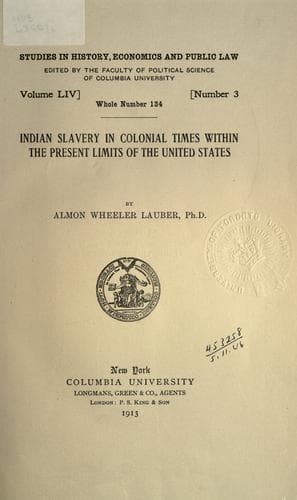
Indian slavery in colonial times within the present limits of the United StatesLauber, Almon Wheeler
History
Indian slavery in colonial times within the present limits of the United States
Lauber, Almon Wheeler
Indians of North America; Indians, Treatment of -- United States; Slavery -- United States; Thesis (Ph. D.)
The popular idea that baptism conferred freedom upon slaves aroused
eventually so much discussion among both the colonists and the
representatives of the Society for the Propagation of the Gospel
in Foreign Parts, and so many inquiries were addressed to the home
government concerning the matter, that in 1729 the opinions of Talbot
and Yorke, the attorney and solicitor generals of England, were
expressed on the subject. Their decision was in accord with the acts
of the various colonial legislatures to the effect that baptism did
not confer freedom upon slaves. The declaration of Gibson, Bishop of
London, about the same time, also, that “Christianity and the embracing
of the Gospels does not make the least alteration in civil property”,
practically ended the discussion.[1065]
Turning now to a consideration of the question of manumission, it
may be said that an Indian slave, like a negro of like condition,
might obtain freedom during the latter’s lifetime, or by testamentary
disposition at the owner’s death. His freedom might be purchased
either by himself or others. A colonial court might declare him free
if it were found that he was illegally held or misused. A colonial
government, also, might grant him freedom for some special service
rendered.
Action of the owner was naturally the most common way of conferring
freedom.[1066] When freedom was bestowed during the owner’s lifetime,
a deed of manumission was usually given in order to avoid future
complications.[1067] Occasionally in special instances the colonial
government recognized such action of the slave owners as legal. For
instance, the South Carolina Board of Counsel, August 3, 1711, in
its directions to the Indian traders provided that any Indians taken
captive in war and declared free by their respective masters who had a
right so to act, should be deemed free men.[1068]
Record exists of Indian slaves purchasing their freedom from two
sources, viz.: the colonial governments that held them before they
were transferred to individual owners, and the individual masters
themselves. In Plymouth, March 5, 1668, it was ordered that a certain
Indian held at Boston “for matter of fact”, since there was “a
probability of a tender of some land for his ransom from being sent
to Barbadoes”, should be freed from such slavery on the tender of the
land in question.[1069] A similar instance occurred in Connecticut. One
of the earliest land grants of that colony was conveyed to its owner
by the Indian chief, Uncas, in 1678, in exchange for Betty, an Indian
woman taken captive in King Philip’s War.[1070] Experience Mayhew
relates the instance of an Indian slave who, after his master’s death,
purchased his freedom from his mistress on easy terms, “his master
having never designed to keep him a slave all his days”.[1071] Another
instance, in 1709, shows an Indian slave woman sold to a free Indian to
become his wife, in return for certain land.[1072]
Public-domain text, read in full here on John Shaqi.
Reviews
Reviews
No reviews yet
Be the first to share your thoughts on this work.
Elsewhere in the archive
Join the Discussion
Join the discussion
Sign in to leave a comment or review.
Sign InorCreate an account