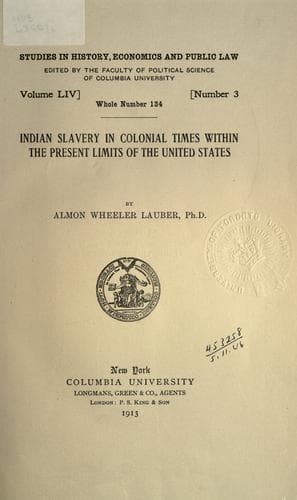
Indian slavery in colonial times within the present limits of the United StatesLauber, Almon Wheeler
History
Indian slavery in colonial times within the present limits of the United States
Lauber, Almon Wheeler
Indians of North America; Indians, Treatment of -- United States; Slavery -- United States; Thesis (Ph. D.)
By South Carolina law, an Indian slave was given a chance to prove his
right to freedom. According to the act of 1712, any negro, mulatto,
mustee or Indian slave, claiming freedom for certain reasons specified
in the act, had the right to have his case heard and determined by
governor and council.[1073] The act was repeated in 1722.[1074] By the
terms of the acts of 1735[1075] and 1740,[1076] any slave might apply
to the justices of the Court of Common Pleas by petition or motion. The
court would then appoint a guardian for “said negro or Indian, mulatto
or mestizo”; and, after hearing evidence, would render decision. The
alleged owner might defend himself, and if the plaintiff were declared
free, the jury might award damages to the defendant. If the defendant
should win the case, the court might inflict such corporal punishment
on the plaintiff as it should see fit, not extending to danger to
life or limb. The burden of proof was to lie with the plaintiff, and
any such negro, Indian, etc., was to be considered a slave until the
contrary was proved. Other courts of the province besides the one
mentioned, were to have similar jurisdiction in the matter.
Certain of the colonies specified how slaves might be emancipated. In
1723, Virginia declared that no negro, mulatto or Indian slave was to
be set free upon any pretense whatever except for some meritorious
service, to be adjudged and allowed by the governor and council for the
time being, and a license therefor first obtained. If any slave should
be set free by his owner in any other way, it was declared lawful for
the churchwardens of the parish wherein such slave should reside for
the space of one month following his being freed, to take up and sell
the said negro, mulatto or Indian as a slave at the next court held for
the county.[1077] North Carolina, similarly, in 1741, provided that no
slave was to be freed except for meritorious service, to be adjudged
and allowed by license of the county court. If any owner should free
his slave in any other way, the church wardens of the parish wherein
such “negro, mulatto or Indian” should be found at the expiration of
six months after the manumission, were authorized and required to sell
the said negro, mulatto or Indian as a slave at the next session of the
county court.[1078]
The colonial governments themselves granted freedom to Indian slaves
on special occasions. By an act passed in 1660, Virginia provided that
an Indian sold by another Indian, or an Indian who spoke the English
language and who might desire baptism, should be given his or her
freedom.[1079] In 1675, also, the Massachusetts general court freed the
sister of an Indian whose friendship it wished to assure. The alleged
owner of the slave being able to prove his title, the court ordered
that £5 be paid for the slave’s liberty.[1080]
Public-domain text, read in full here on John Shaqi.
Reviews
Reviews
No reviews yet
Be the first to share your thoughts on this work.
Elsewhere in the archive
Join the Discussion
Join the discussion
Sign in to leave a comment or review.
Sign InorCreate an account