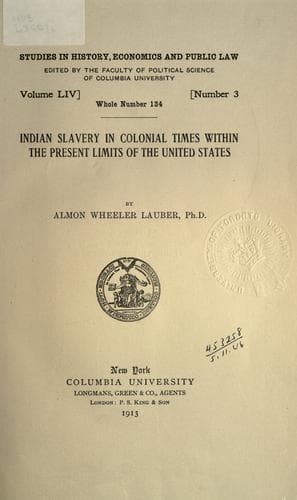
Indian slavery in colonial times within the present limits of the United StatesLauber, Almon Wheeler
History
Indian slavery in colonial times within the present limits of the United States
Lauber, Almon Wheeler
Indians of North America; Indians, Treatment of -- United States; Slavery -- United States; Thesis (Ph. D.)
Some of the colonies considered it advisable to make regulations
regarding the Indians after emancipation. A Virginia act of 1670
specified that former Indian slaves “though baptized and enjoined their
own freedom” could not purchase Christian white servants. The law did
not debar them, however, from buying any of their own race.[1086]
Both New York by the act of 1712,[1087] and New Jersey by the act of
1713,[1088] decreed that no freed Indian could hold any real estate
property in the colony concerned. South Carolina and North Carolina,
also, regarded the presence of manumitted Indians in the colony as
undesirable. The possibility that freedmen of this sort might stir up
disturbance among their fellows who remained in slavery was too great
a risk. A South Carolina act of 1722 decreed that, if owners freed any
slave, they must make provision for his passage out of the province.
Such freedman, if he did not leave the province within twelve months
after his manumission (being at liberty to do so) would lose the
benefit of his emancipation, and continue to be a slave, unless the
manumission were confirmed by both houses of the legislature.[1089] A
further act of 1735 required that the slave when manumitted should quit
the province within the period of six months following his manumission,
and not return within seven years.[1090] The North Carolina act of 1741
specified that, if any freedman did not depart from the province within
six months following his manumission, or should thereafter return to
the province, the church wardens of the parish where he might be at the
end of one month after his return, were to sell him at public auction
at the next session of the county court.[1091]
The freeing of slaves who after their manumission might possess no
means of support and in consequence become a burden upon the community,
presented a problem that often needed attention. Connecticut understood
the value of freeing worn-out slaves so as to avoid supporting them in
their time of uselessness; hence in 1702 the general court enacted that
every slave owner who freed his slave should in the years following
manumission, if the former slave came to want, meet the expense which
the local government encountered in caring for the freedman.[1092]
The act was renewed by the court in 1703.[1093] Another act of
practically the same tenor and including “Spanish Indians” was passed
in 1711.[1094] An act of 1777, also, relieved the former owner of a
freedman from any obligation to contribute to his support if the act
of manumission had been sanctioned in due form by the selectmen of the
former owner’s town.[1095]
Public-domain text, read in full here on John Shaqi.
Reviews
Reviews
No reviews yet
Be the first to share your thoughts on this work.
Elsewhere in the archive
Join the Discussion
Join the discussion
Sign in to leave a comment or review.
Sign InorCreate an account