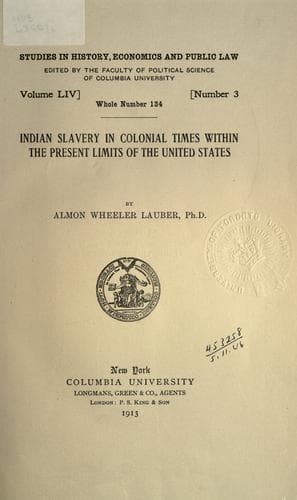
Indian slavery in colonial times within the present limits of the United StatesLauber, Almon Wheeler
History
Indian slavery in colonial times within the present limits of the United States
Lauber, Almon Wheeler
Indians of North America; Indians, Treatment of -- United States; Slavery -- United States; Thesis (Ph. D.)
A New York law of 1712, on the other hand, provided that any one
manumitting “any negro, Indian or mulatto slave” should give security
of not less than £200 to pay yearly to such freed slave the sum of
£20 lawful money of the colony. If the slave were freed by will
and testament, the executors of the deceased person were required
to give the same security after probate. If such security were not
given, the manumission should be void.[1096] Since the law proved to
be unsatisfactory, in 1717 it was amended so as to provide that any
master or other person manumitting an Indian or negro slave should give
security at the General Sessions of the Peace for city and county where
such freed Indian or negro should reside, to keep such freedman from
becoming a charge on the city, town or place.[1097]
New Jersey, too, in 1713, passed an act declaring that no negro or
mulatto slave could be manumitted unless the slave’s master gave surety
to pay such freed slave £20 yearly.[1098] This is the only section
of the act which did not include Indian slaves in its provisions.
Evidently the omission was unsatisfactory, for a later act, November
16, 1769, repealed the section and provided that, if any owner should
by will or otherwise free “any negro, Indian or mulatto slave”, then
such owner, his heirs or executors, at the next session of the Court of
General Quarter Sessions of the Peace in the county where such owner
resided, must give a bond of £200, so as to indemnify the community if
such freedman became a pauper.[1099]
CHAPTER XII
+The Decline of Indian Slavery+
The small number of the Indians within the territory actually occupied
by the English had its influence upon both the extent and the decline
of Indian slavery. The Indians were never as numerous in the English
territory as in that occupied or claimed by the Spanish and French.
From many estimates made of the Indian population in the section under
English rule,[1100] it would seem that the supply was sufficient to
nourish the system of Indian slavery indefinitely: but it must be noted
that the greater portion of this Indian population was made up of
tribes generally remote from the English settlements.
The consensus of opinion to-day is that the number of Indians in
New England about the year 1600 was not greater than twenty-four or
twenty-five thousand. This number was so much reduced by the plague of
1616,[1101] that Palfrey states that the English found practically a
vacant domain.[1102] In the Florida country many small tribes were so
thoroughly exterminated before the coming of the whites that no trace
of their existence remained except a few local names.[1103] In the
interior of the continent before the French or the English had obtained
a foothold, the whole country during the seventeenth century was the
seat of intertribal wars so disastrous in their results as to destroy
many large and powerful tribes.[1104]
Public-domain text, read in full here on John Shaqi.
Reviews
Reviews
No reviews yet
Be the first to share your thoughts on this work.
Elsewhere in the archive
Join the Discussion
Join the discussion
Sign in to leave a comment or review.
Sign InorCreate an account