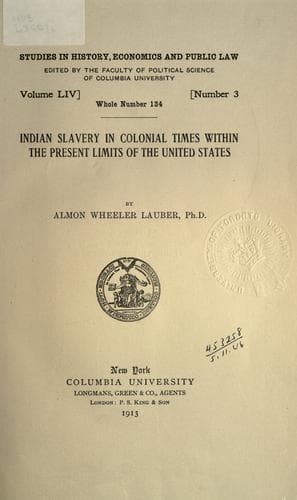
Indian slavery in colonial times within the present limits of the United StatesLauber, Almon Wheeler
History
Indian slavery in colonial times within the present limits of the United States
Lauber, Almon Wheeler
Indians of North America; Indians, Treatment of -- United States; Slavery -- United States; Thesis (Ph. D.)
With the coming of the white races the decrease in the number of the
Indians went on rapidly. Estimates show such to have been the case with
the Indians of the North Atlantic coast during the first quarter of
the eighteenth century.[1105] Bradford[1106] and Winthrop[1107] bear
witness to the small number of the natives, and to the further decrease
of that number after the coming of the whites. An early writer on New
York declares: “There is now (1670) but few Indians upon the island and
those few no ways hurtful. It is to be admired how strangely they have
decreased by the hand of God, since the English first settling in these
parts.”[1108] Oldmixon gives the number of Indian men in New York in
1708 as one thousand, “whereas there are seven or eight times as many
English.”[1109] According to the same authority, the number of Indians
in New Jersey at the opening of the eighteenth century did not exceed
two hundred.[1110]
A decreased birth-rate was not the least important cause of this
decrease in numbers throughout all the tribes. Following the advent of
the whites in the new world, “sterility became the rule and not the
exception”, where before the Indians were very prolific.[1111] The
natives, bond or free, seemed to possess a peculiar susceptibility
to the diseases of the whites, and a lack of ability to withstand
their effects. The Indians of the Delaware River country complained
that during the sixteen years after the coming of the Swedes, their
number had been much diminished, presumably by small-pox.[1112] In
both North and South Carolina, the Indians were much afflicted by
this same disease in early colonial days, one tribe being entirely
swept away,[1113] another nearly exhausted,[1114] and still others
much reduced in numbers.[1115] Owing to diseases and other causes the
several tribes in Carolina at the opening of the eighteenth century
were small, most of them not numbering more than fifty men each.[1116]
Douglass recorded that the Spanish Indians captured at St. Augustine
and brought to New England, soon died of consumption.[1117]
Dean Berkeley who repeatedly visited Narragansett to examine the
conditions and character of the Indians of that locality, in his sermon
before the Society for the Propagation of the Gospel in Foreign Parts
at its anniversary in 1731, bears witness to such destruction in the
following statement: “The native Indians, who are said to have been
thousands within the compass of this colony, do not at present amount
to a thousand, including every age and sect; ... the English [having]
contributed more to destroy their bodies by the use of strong liquors,
than by any means to improve their minds or save their souls. This slow
poison, jointly operating with the small-pox, and their wars, (but much
more destructive than both), has consumed the Indians, not only in our
colonies, but also far and wide upon our confines.”[1118]
Public-domain text, read in full here on John Shaqi.
Reviews
Reviews
No reviews yet
Be the first to share your thoughts on this work.
Elsewhere in the archive
Join the Discussion
Join the discussion
Sign in to leave a comment or review.
Sign InorCreate an account