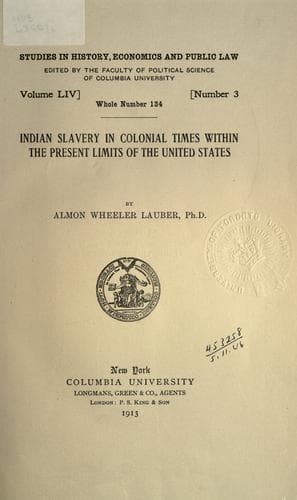
Indian slavery in colonial times within the present limits of the United StatesLauber, Almon Wheeler
History
Indian slavery in colonial times within the present limits of the United States
Lauber, Almon Wheeler
Indians of North America; Indians, Treatment of -- United States; Slavery -- United States; Thesis (Ph. D.)
Intestine wars, often, as has been seen, fostered by the whites,
resulted in great loss of numbers to the Indians, and sometimes even
destroyed whole tribes. In consequence of a war between the Yoamaco
Indians of Maryland and the Susquehanna, the former disappeared.[1119]
In Virginia, between 1609 and 1669, spirituous liquors, the small-pox,
war and a diminution of territory reduced the tribes to one-third of
their original number.[1120] During the next twenty years they had
become so much weakened that three of their principal tribes were able
to send to a great Indian congress only four representatives, including
attendants. By the end of the next century all had perished, except
three or four of one tribe, ten or twelve of another, and a few women
only of a third.[1121]
By 1780 all the Indian nations of the territory settled by the
English in the south were either extinct or had retreated westward
and had united with the neighboring Cherokee and Creeks. At this
time the Catawba were so reduced that they possessed but seventy or
eighty men.[1122] The Westo and Savannah were likewise reduced from
many thousands to small numbers,[1123] and the Corannine tribe was
practically destroyed.[1124]
Another cause which contributed in a measure to the passing of Indian
slavery was the amalgamation of the red and black slaves. Since
intercourse and marriage of slaves were not generally interfered with
by the whites, it was natural that the slaves of the red and black
races should intermingle. Since, also, the Indians were generally
in the minority, as well as inferior in power of resistance, their
physical characteristics gradually disappeared, while those of the
negro remained.
By his very constitution, furthermore, the Indian seemed unfitted for
servitude. He was highly susceptible to climatic changes, and unable to
endure sustained labor. In his native condition he was accustomed at
times to great tests of physical endurance, which, however, alternated
with periods of rest and recuperation. Though authorities may differ
as to the capacity of the Indian for civilization, the fact remains
that civilization has only to a very small extent been assimilated
by the red man. Taking into due consideration the treatment accorded
him by the whites, the conclusion seems warranted that such lack of
assimilation is due in some measure to the inability of the Indian to
develop beyond the stage which he had already reached when discovered
by the Europeans. Furthermore, the dominant idea of Indian life was the
love of liberty. Heredity and environment coöperated to make the Indian
a creature opposed to all restraint when exercised by an exterior
force.[1125]
Public-domain text, read in full here on John Shaqi.
Reviews
Reviews
No reviews yet
Be the first to share your thoughts on this work.
Elsewhere in the archive
Join the Discussion
Join the discussion
Sign in to leave a comment or review.
Sign InorCreate an account