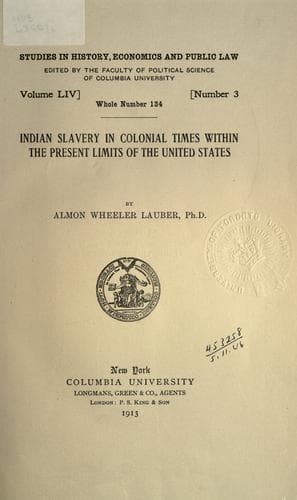
Indian slavery in colonial times within the present limits of the United StatesLauber, Almon Wheeler
History
Indian slavery in colonial times within the present limits of the United States
Lauber, Almon Wheeler
Indians of North America; Indians, Treatment of -- United States; Slavery -- United States; Thesis (Ph. D.)
The general conclusion, therefore, so far as it can be determined by
individual testimony, colonial legislative action and the comparative
values of Indian and negro slaves, is that Indian slave labor within
the territory under discussion was not, as a rule, satisfactory. Mason
records that the captives distributed among the colonists as slaves
at the close of the Pequot War “could not endure that yoke; few of
them continuing any considerable time with their masters”.[1126]
Mayhew tells in 1690 of the tendency to run away shown by the Indian
slaves of Massachusetts.[1127] Moses Marcy of Oxford, Massachusetts,
had an Indian woman sold him by the general court prior to 1747. In
that year he was discharged from his bond, she having “made way with
herself after having tried to murder her mistress ... run off and not
heard from since”.[1128] It is stated that the Indian female slaves
of New England could not be taught to sew, to wash clothes, or to
render any valuable domestic service;[1129] and that the Indian slaves
of Rhode Island “only became efficient workmen under a stern and
vigorous discipline”.[1130] Sir Robert Mountgomry, who advocated in
1717 the establishment of a colony south of Carolina, urged the use of
indentured white servants, so that there might be “no necessity to use
the dangerous help of Blackamoors or Indians”.[1131]
The various laws, already discussed in another connection, and the
numerous newspaper advertisements show Indian slaves to have been as
much given to running away as their negro companions. In fact it seems
not unlikely that they were more inclined toward trying to escape, for
the possible chance of returning to their own people offered greater
inducements for such an act than in the case of negroes.
Indian slaves as well as negroes were implicated in the various
slave disturbances which occurred from time to time in the different
colonies. Though there seems no evidence that Indians were usually more
instrumental than negroes in creating these disturbances, yet their not
infrequent participation in such events tended to lower the colonists’
estimate of their value, and led to definite legislation seeking, by
preventive measures and by decreeing severe punishments in case of
conspiracies or uprisings, to avoid the danger which the colonists
feared.
Public-domain text, read in full here on John Shaqi.
Reviews
Reviews
No reviews yet
Be the first to share your thoughts on this work.
Elsewhere in the archive
Join the Discussion
Join the discussion
Sign in to leave a comment or review.
Sign InorCreate an account