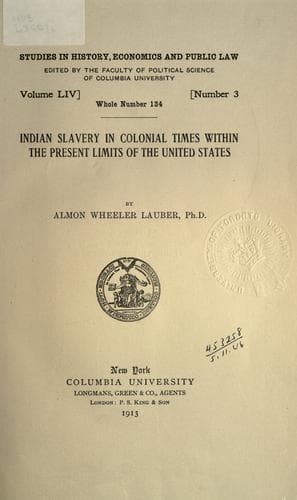
Indian slavery in colonial times within the present limits of the United StatesLauber, Almon Wheeler
History
Indian slavery in colonial times within the present limits of the United States
Lauber, Almon Wheeler
Indians of North America; Indians, Treatment of -- United States; Slavery -- United States; Thesis (Ph. D.)
Legislation regarding slave conspiracies and uprisings was general
throughout the English colonies from an early date. In some of
these acts Indian slaves were expressly mentioned. In others they
were included by implication in the general term “slaves” or in the
expression “negroes and other slaves”. Reference will be made to only
those acts which include Indian slaves by express mention. A South
Carolina act of 1690 related to Indian and negro slaves striking a
white person.[1132] The Spanish Indians were evidently considered
especially undesirable, for an act passed in 1722 stated that “the
importation of Spanish Indians, mustees, negroes and mulattoes may be
of dangerous consequence....”[1133] In 1703, Massachusetts passed “an
act to prevent disorder in the night”. The preamble reads: “whereas
great disorders, insolences and burglaries are oftimes raised and
committed in the night time by Indian, negro and mulatto servants
and slaves....”[1134] As late as 1769 Connecticut passed an act
relating to any disturbance created by “any Indian, negro, or mulatto
slave.”[1135] The murder by an Indian man slave and a negro woman of
an entire white family in Queens County, New York, led to the passage
of an act, October 30, 1708, to prevent the conspiracy of Indian and
negro slaves.[1136] A Philadelphia ordinance, also, of July 3, 1738,
dealt with “the tumultuous meetings and other disorderly doings of
the negroes, mulattoes and Indian servants and slaves within the
city”.[1137]
A second class of colonial laws related to Indian slaves alone and
show that in certain of the colonies the inhabitants, for definite
reasons, feared the presence of too many Indian slaves among them.
Such were the laws passed by the northern colonies at the time of
the Tuscarora War, by which they sought by means of heavy duties to
prevent the importation of such dangerous slaves.[1138] The preamble
of the Massachusetts act of 1713, for example, reads: “Whereas divers
conspiracies, outrages, barbarities, murders, burglaries, thefts and
other notorious crimes and enormities, at sundry times, and especially
of late, have been perpetuated and committed by Indian and other slaves
within several of her majestie’s plantations in America, being of a
malicious, surley and revengeful spirit, rude and insolent in their
behaviour, and very ungovernable, the over-great number and increase
whereof within this province is likely to prove of pernicious and
fatal consequences to her majestie’s subjects and interest here unless
speedily remedied, and is a discouragement to the importation of white
Christian servants, this province being differently circumstanced from
the plantations in the islands, and having great numbers of the Indian
natives of the country within and about them, and at this time under
the sorrowful effects of their rebellion and hostilities....”[1139] The
Connecticut act passed in August, 1715, likewise for the purpose of
Public-domain text, read in full here on John Shaqi.
Reviews
Reviews
No reviews yet
Be the first to share your thoughts on this work.
Elsewhere in the archive
Join the Discussion
Join the discussion
Sign in to leave a comment or review.
Sign InorCreate an account