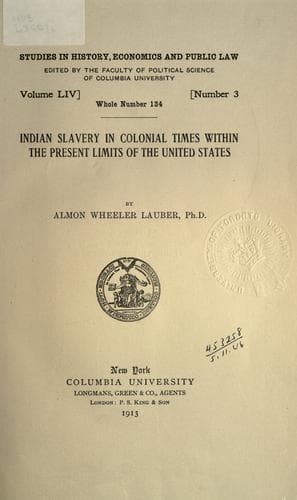
Indian slavery in colonial times within the present limits of the United StatesLauber, Almon Wheeler
History
Indian slavery in colonial times within the present limits of the United States
Lauber, Almon Wheeler
Indians of North America; Indians, Treatment of -- United States; Slavery -- United States; Thesis (Ph. D.)
A comparison of these prices paid for Indian slaves shows much
variation at different times and places. In New England after the
Indian wars the prices were low, for the chief object of the government
was to get rid of the captives. In localities where the Indian’s labor
was in greater demand the prices rose and appear to have been highest
among the English of the southern colonies. When compared with sums
paid for negroes at the same time and place, the prices of Indian
slaves are found to have been considerably lower. In general the prices
of slaves increased during the years preceding the Revolution, but the
values of Indian slaves did not equal those of negro slaves.
During the existence of Indian slavery, furthermore, there was never
any general expression of opinion regarding it either in England[1226]
or America, nor are there many records of opinions expressed during
the colonial period as to the right or wrong of enslaving the natives.
The English colonists followed the Spanish custom of reducing the
Indians to a condition of slavery, but neither the English colonists
nor the English government heeded the example of the later policy of
the Spanish government in looking upon Indian slavery as unjust and
declaring it illegal.
That personal opinions favorable or unfavorable to the enslavement of
Indians were not more generally expressed is not altogether strange.
The enslavement was not premeditated nor did it spring into sudden
existence throughout the English colonies, but began here and there in
various colonies at various times and for various reasons. The custom
of enslavement came from the necessity of disposing of war captives,
from the greed of traders and from the demand for labor. Individuals
in the colonies, such as officials of high rank and church leaders,
who would naturally be expected to express an opinion either for or
against the custom, themselves held Indian slaves quite as a matter of
course, and found no necessity for discussing their action. Nor did the
possession and employment of Indian slaves ever become sufficiently
extensive to present any of the problems which later attracted the
attention of the people and led to the opposition which overthrew
negro slavery in several of the colonies, and incidentally, Indian
slavery as well.
Public-domain text, read in full here on John Shaqi.
Reviews
Reviews
No reviews yet
Be the first to share your thoughts on this work.
Elsewhere in the archive
Join the Discussion
Join the discussion
Sign in to leave a comment or review.
Sign InorCreate an account