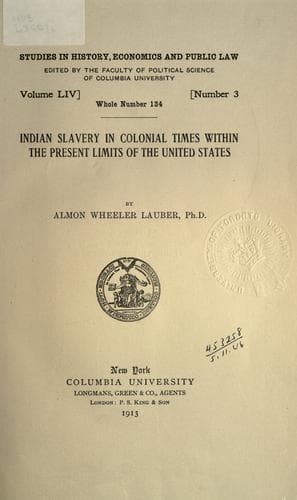
Indian slavery in colonial times within the present limits of the United StatesLauber, Almon Wheeler
History
Indian slavery in colonial times within the present limits of the United States
Lauber, Almon Wheeler
Indians of North America; Indians, Treatment of -- United States; Slavery -- United States; Thesis (Ph. D.)
Yet throughout the history of Indian slavery certain expressions of
opposition to the system, usually mild in nature, occurred from time
to time. In the English colonies there was never any such earnest
opponent to Indian slavery as the Spaniard, Las Casas, who argued
directly against the enslavement of Indians from the standpoint of the
injustice of reducing the natives to such a condition. Most of the
opposition expressed in the English colonies was aimed at some specific
instance of harsh treatment or cruel punishment of which enslavement
was an incident; or it arose during the later colonial period as a part
of the antagonism to slavery in general; or, as was the case in South
Carolina, it revealed the attitude of one faction of the government
toward the actions of another faction, and was not at all concerned in
abolishing the practice of enslaving Indians as such.
The system adopted by Rhode Island at the time of King Philip’s War
of using the captive Indians as involuntary indentured servants for
short periods of years, was anticipated by the query expressed by Roger
Williams in his letter to Governor Winthrop, September 18, 1637, as
to whether the captive Indians whose lives were spared should not be
retained in involuntary servitude for short periods of time and then
be released.[1227] This spirit of opposition to the enslavement of
Indian captives for life, shown by Rhode Island during both the Pequot
and King Philip wars, was somewhat out of harmony with the spirit of
the times. But it should be noted that this opposition was not the
expression of the entire colony. During the Pequot War it represented
the feeling of the “Liberal Party” against the enslavement of the
captive Indians, and during King Philip’s War it resulted from the
dominating influence of the Quaker element in the government.
Public-domain text, read in full here on John Shaqi.
Reviews
Reviews
No reviews yet
Be the first to share your thoughts on this work.
Elsewhere in the archive
Join the Discussion
Join the discussion
Sign in to leave a comment or review.
Sign InorCreate an account