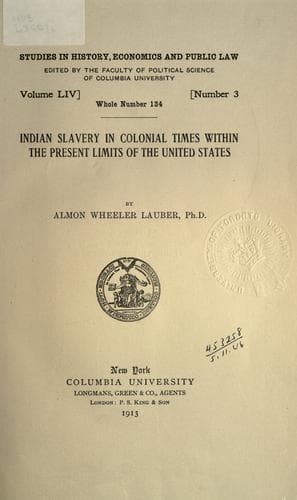
Indian slavery in colonial times within the present limits of the United StatesLauber, Almon Wheeler
History
Indian slavery in colonial times within the present limits of the United States
Lauber, Almon Wheeler
Indians of North America; Indians, Treatment of -- United States; Slavery -- United States; Thesis (Ph. D.)
The opposition of John Eliot to the enslavement of Indians during King
Philip’s War was similar to that shown by Roger Williams during the
Pequot War, though perhaps it was prompted by a more nearly unselfish
and humanitarian motive. Throughout the war Eliot remonstrated strongly
against selling the captive Indians into slavery. In a letter, June
13, 1675, to the governor and council at Boston, he stated his reasons
for opposing the enslavement of the captives. He first urged a politic
reason: that such enslavement was likely to prolong the war and bring
still further disaster upon the land by rousing the Indians to renewed
hostilities. He then emphasized the Christian attitude of mercy by
asserting that it is the design of Christ “not to extirpate nations but
to Gospelize them”. “To sell souls for money,” he continued, “seems to
me a dangerous merchandise. To sell them away from all means of grace,
when Christ has provided means of grace for them, is the way for us
to be active in the destroying of their souls.” His plea for mercy
was strengthened, also, by calling attention to the letters patent
of the king which urged the Indians’ conversion rather than their
destruction.[1228]
Some faint opposition to the enslavement of Indians was expressed by
Samuel Sewall of Massachusetts in 1706, called forth by an act passed
by Massachusetts against Indians and negroes. Perhaps something was
accomplished by the protest, though the act either failed to pass or
was repealed, since no trace of it remains.[1229]
In 1729, Ralph Sandiford published a work entitled: “The Mystery of
Iniquity in a Brief Examination of the Practice of the Times.” In the
dedication of his book, he speaks of going to South Carolina, and of
refusing the bounty of a rich colonist there because his riches had
been obtained through the labor of negro and Indian slaves. He declares
that negroes and Indians who are the Lord’s freemen cannot be slaves to
Christians.[1230] He further asserts that the matter he is aiming at is
“this trading in mankind, which is pernicious to the Publick, but more
especially to the common-wealth of Israel; which raised forth a zeal
in Men for the House of the Lord, which would have even consumed men
had not I witnessed against this rottenness and hypocrisy that would
introduce itself amongst the saints, whereby, as way-marks, they lead
many into the same corrupt practice which is contrary to the Principal
of Truth, which is over the Heads of such Transgressors, that the
Righteous in all Churches are undefiled with it, for their Bodies are
the Temples of the Holy Ghost to dwell in, which they cannot defile
with Babylon, who is Harloted from the Truth to feed upon the Flesh or
receive nourishment from the blood of the poor Negro or Indian captive,
or whomsoever ravenous Nature (which is the Beast’s work) has power to
prey upon”.[1231]
Public-domain text, read in full here on John Shaqi.
Reviews
Reviews
No reviews yet
Be the first to share your thoughts on this work.
Elsewhere in the archive
Join the Discussion
Join the discussion
Sign in to leave a comment or review.
Sign InorCreate an account