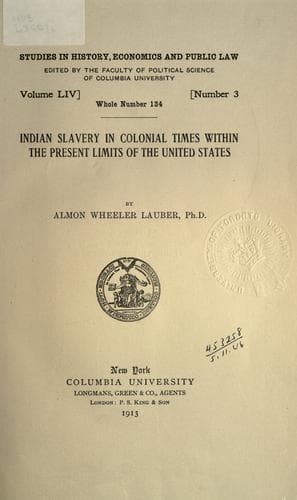
Indian slavery in colonial times within the present limits of the United StatesLauber, Almon Wheeler
History
Indian slavery in colonial times within the present limits of the United States
Lauber, Almon Wheeler
Indians of North America; Indians, Treatment of -- United States; Slavery -- United States; Thesis (Ph. D.)
Throughout the colonial period the Society of Friends showed more or
less opposition to slavery, although the members of the Society held
slaves. From 1688 a certain amount of agitation concerning the matter
is apparent in the records of the various quarterly and yearly meetings
in Pennsylvania and the Jerseys. In the records of the Philadelphia
Yearly Meeting for the year 1719, is found the first mention of Indian
slaves made in the minutes of the Yearly Meeting. In that year, after
an earnest admonition to Friends to refrain from selling, trading or
exchanging in any way any spirituous liquors with the Indians, the
Yearly Meeting voted: “And to avoid giving them occasion of discontent,
it is desired, that Friends do not buy or sell Indian slaves.”[1235]
From the wording of the record it may be concluded that the basis for
the Friends’ action was not the idea of any moral wrongdoing attached
to the enslavement of Indians, but rather the possible harm that might
come to the colony through the discontent which enslavement might
cause among the free Indians. And, judging from the previous action
of the Society taken with regard to slavery, it may also be concluded
that this basis for the opposition to the trade in Indian slaves was
used as a means of calling the immediate attention of its members to
the matter, and that the reason for the opposition of the Meeting to
trading in Indians was the same as that to negro slavery: “caution not
censure”.[1236]
Some criticism was expressed in Massachusetts at the seizure of the
Indians at Cocheco in 1676, and the subsequent transportation of
part of the number captured by order of the government.[1237] Such
criticism, however, was not aimed at the action of the government in
selling the Indians as slaves, but at the breach of faith in seizing
Indians at peace.
In South Carolina, as already observed,[1238] the proprietors
sanctioned enslavement of Indians when carried on for their own
financial benefit, and opposed it when carried on by the colonial
authorities. The colonial officials favored the practice and carried
it on both as a means of meeting colonial expenses and as a source of
personal income. In this respect the action of the existing colonial
government of South Carolina differs materially from that of the
officials of any other colony. Nowhere else was the desire for personal
gain a controlling cause for the disposal of captives taken in war and
hence colonial property.
Public-domain text, read in full here on John Shaqi.
Reviews
Reviews
No reviews yet
Be the first to share your thoughts on this work.
Elsewhere in the archive
Join the Discussion
Join the discussion
Sign in to leave a comment or review.
Sign InorCreate an account