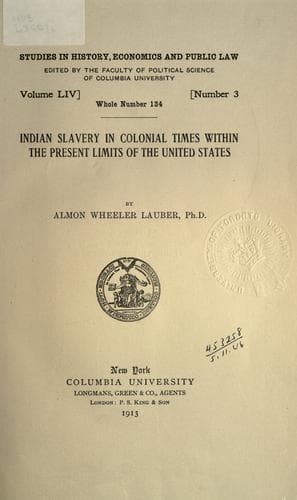
Indian slavery in colonial times within the present limits of the United StatesLauber, Almon Wheeler
History
Indian slavery in colonial times within the present limits of the United States
Lauber, Almon Wheeler
Indians of North America; Indians, Treatment of -- United States; Slavery -- United States; Thesis (Ph. D.)
In contrast to these incidental expressions of personal opposition to
the enslavement of Indians, stands the ownership and employment of them
by leading colonists.[1239] The New Englanders not only bought Indians
at the time of the Indian wars, but also sent requests to the colonial
officials for them. Captain Stoughton wrote to Governor Winthrop from
the scene of the Swamp Fight: “By this pinnace, you shall receive 48
or 50 women and children, unless there stay any here to be helpful,
concerning which there is one, I formerly mentioned, that is the
_fairest_ and _largest_ amongst them to whom I have given a coate to
cloathe her. It is my desire to have her for a servant, if it may stand
to your good liking, else not. There is a little squaw that steward
Culacut desireth, to whom he hath given a coate. Lieut. Davenport also
desireth one, to wit, a small one, that has three strokes upon her
stomach.... He desireth her, if it will stand with your good liking.
Sosomon, the Indian, desireth a young little squaw, which I know
not.”[1240] The Reverend Hugh Peter also wrote to Governor Winthrop in
1637: “Mr. Endecot and my selfe salute you in the Lord Jesus, etc. Wee
haue heard of a diuidence of women and children in the bay and would
bee glad of a share viz: a young woman or girle and a boy if you thinke
good: I wrote to you for some boyes for Bermudas, which I thinke is
considerable.”[1241] In July, 1637, Roger Williams petitioned Governor
Winthrop for an Indian as follows: “It having againe pleased the Most
High to put into your hands another miserable droue of Adams degenerate
seede, & our brethren by nature, I am bold (if I may not offend in
it) to request the keeping & bringing vp of one of the children. I
haue fixed mine eye on this litle one with the red about his neck, but
I will not be peremptory in my choice, but will rest in your loving
pleasure for him or any, &c.”[1242] The barrister, Emanuel Downing,
writing to John Winthrop in 1645, clearly illustrates the view of his
day. He says: “A warr with the Narraganset is verie considerable to
this plantation, ffor I doubt whither yt be not synne in vs, hauing
power in our hands, to suffer them to maynteyne the worship of the
devill which their paw wawes often doe; 2lie, If vpon a Just warre the
Lord should deliuer them into our hands, wee might easily haue men
woemen and children enough to exchange for Moores, which wilbe more
gaynefull pilladge for vs then wee conceive, for I doe not see how wee
can thrive vntill wee gett into a stock of slaves sufficient to doe all
our buisines, for our children’s children will hardly see this great
Continent filled with people, soe that our servants will still desire
freedome to plant for them selues, and not stay but for verie great
wages. And I suppose you know verie well how wee shall maynteyne 20
Moores cheaper then one Englishe servant.”[1243]
Public-domain text, read in full here on John Shaqi.
Reviews
Reviews
No reviews yet
Be the first to share your thoughts on this work.
Elsewhere in the archive
Join the Discussion
Join the discussion
Sign in to leave a comment or review.
Sign InorCreate an account