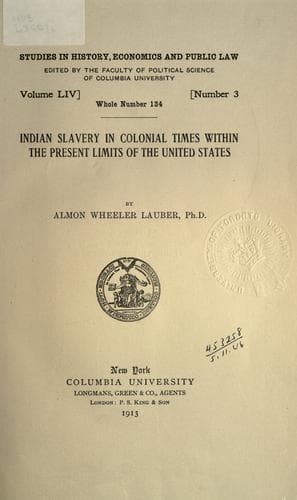
Indian slavery in colonial times within the present limits of the United StatesLauber, Almon Wheeler
History
Indian slavery in colonial times within the present limits of the United States
Lauber, Almon Wheeler
Indians of North America; Indians, Treatment of -- United States; Slavery -- United States; Thesis (Ph. D.)
[500] In a letter to the governor of South Carolina, May 1, 1704,
Moore states that he has taken all the people of three towns, and the
greatest part of four more, and that he has with him thirteen hundred
free Apalachee Indians and one hundred slaves. Carroll, _op. cit._, ii,
pp. 574–576.
[501] _The Statutes at Large of South Carolina_, ii, pp. 322, 325.
[502] _Ibid._, ii, p. 637.
[503] Martin, _The Public Acts of the General Assembly of North
Carolina_, etc., edition of 1804, p. 135. If such an Indian should be
killed, the captor was to secure £10 from the public treasury. This
amount was probably less than the regular price of such slaves, for if
the amount were equal to the full value, the captor would have been
tempted to kill the captive, and thus avoid the trouble of keeping him.
Bassett, _Slavery and Servitude in the Colony of North Carolina_, p.
73, in _Johns Hopkins University Studies_, xiv.
[504] _North Carolina Colonial Records_, xiii, pp. 204–205, contains
a letter of President Lowndes of South Carolina to Governor Caswell
of North Carolina, August 6, 1778, concerning the adjustment of this
matter. As late as 1776 Cherokee prisoners of war were sold to the
highest bidder in South Carolina, _Nineteenth Annual Report of the
Bureau of American Ethnology_, p. 223; Basset, _op. cit._, p. 73, in
_Johns Hopkins University Studies_, xiv.
[505] Hoadly, _Records of the Colony or Jurisdiction of New Haven, from
May, 1653, to the Union_, etc., p. 177.
[506] _Plymouth Colony Records_, ix, p. 4.
[507] _Ibid._, ix, p. 35.
[508] _Plymouth Colony Records_, v, p. 173.
[509] _Ibid._, v, p. 174.
[510] _Ibid._, v, p. 173; ix, p. 401.
[511] _Ibid._, xi, p. 242.
[512] Shurtleff, _op. cit._, v, p. 115.
[513] Baylies, _op. cit._, ii, pt. iii, p. 75.
[514] Hough, _op. cit._, pp. 188–189. It is to be noted that none
of the Indians transported were allowed to return to the colonies.
This same court, on rumors of Indians landing near the coast of Rhode
Island, forbade the landing of any Indian on the shores of Rhode Island
or Narragansett Bay. Hough, _op. cit._, p. 189.
[515] See Sylvester, _op. cit._, ii, p. 457, for expedients adopted by
Massachusetts to obtain money to defend the frontiers. Yet the number
killed and sold, along with those who escaped, practically destroyed
the warring Indians. According to the Massachusetts Records of
1676–1677 a day was set apart for public thanksgiving, because, among
other things of moment, “there now scarce remains a name or family of
them (the Indians) but are either slain, captivated or fled.”
Public-domain text, read in full here on John Shaqi.
Reviews
Reviews
No reviews yet
Be the first to share your thoughts on this work.
Elsewhere in the archive
Join the Discussion
Join the discussion
Sign in to leave a comment or review.
Sign InorCreate an account