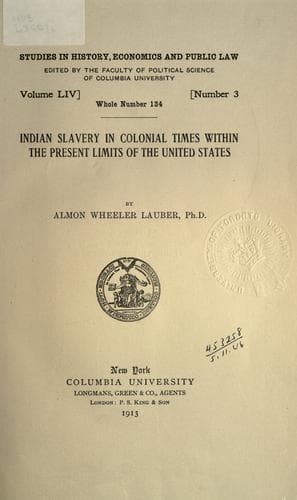
Indian slavery in colonial times within the present limits of the United StatesLauber, Almon Wheeler
History
Indian slavery in colonial times within the present limits of the United States
Lauber, Almon Wheeler
Indians of North America; Indians, Treatment of -- United States; Slavery -- United States; Thesis (Ph. D.)
[516] Both Plymouth and Massachusetts, by encouraging, as a part of
the war policy, the capture of Indians alive, through legalizing
such capture or granting a specified reward for each captive,
unintentionally increased the number of Indian captives that could be
sold. In a declaration issued by the New England commissioners at the
beginning of the war, it was declared “lawful for any person, whether
English or Indian, that shall find any Indians traveling or skulking
in any of the towns or roads (within specified limits), to command
them under their guard and examination, or to kill them as they may or
can.” To this direction was added: “The council hereby declaring, that
it will be most acceptable to them that none be killed or wounded that
are willing to surrender themselves into custody.” Halkett, _Historical
Notes respecting the Indians of North America_, p. 135.
In the eastern campaign Massachusetts offered twenty shillings bounty
for every Indian scalp, and forty shillings for every prisoner. The
individual towns sometimes took similar action. For instance, the
people of Monhegan publicly offered a bounty of £5 for every Indian
that should be brought in. In 1694, Massachusetts decreed that
volunteers were to have for every Indian, great or small, which they
should kill or bring in prisoner, £50, as well as all plunder. Soldiers
under pay were to receive, over and above pay, £10. In 1695, £25 was
decreed as the reward for any Indian woman or young person under
fourteen years of age. _Acts and Resolves_, i, pp. 176, 211, 292.
[517] _Historical Magazine_, x, p. 188.
[518] Douglas, _A Summary, Historical and Political_, etc., i, p. 557.
[519] _Acts and Resolves_, viii, p. 45.
[520] _Ibid._, i, 530.
[521] Church, _op. cit._, Dexter edition, i, p. 189. For the successful
expedition of Church in which he captured 126 Indians, see Sylvester,
_Indian Wars of New England_, ii, p. 326.
[522] This last phrase related to a decree of the Plymouth Council of
War, in turn confirmed by the Court, July 23, 1676. Hough, _op. cit._,
pp. 187–189. The bill of sale of one of the Indian women to Adam Right
of Duxbury bears the signature of Church. Weeden, _Early Rhode Island,
a Social History of the People_, p. 178.
Public-domain text, read in full here on John Shaqi.
Reviews
Reviews
No reviews yet
Be the first to share your thoughts on this work.
Elsewhere in the archive
Join the Discussion
Join the discussion
Sign in to leave a comment or review.
Sign InorCreate an account