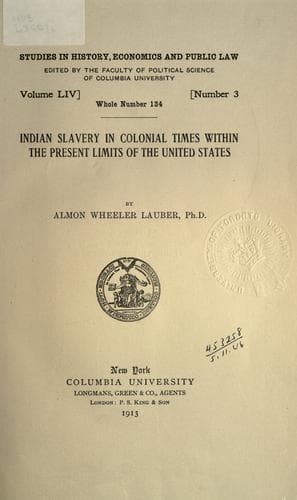
Indian slavery in colonial times within the present limits of the United StatesLauber, Almon Wheeler
History
Indian slavery in colonial times within the present limits of the United States
Lauber, Almon Wheeler
Indians of North America; Indians, Treatment of -- United States; Slavery -- United States; Thesis (Ph. D.)
[523] Gookin, _op. cit._, in _American Antiquarian Society
Collections_, ii, 1836, p. 449. One of the arguments used by the
warring Indians to persuade the Praying Indians to join with them, was
that the English proposed to destroy all the Praying Indians, or sell
them out of the country as slaves. _Ibid._, pp. 462, 476. The feeling
against the Praying Indians was so strong that a council in Boston,
August 30, 1675, disbanded them, and distributed them among five of
their own villages. Gookin, _op. cit._, in _American Antiquarian
Society Collections_, ii, 1836, p. 450. Most of the Indians were sent
to Deer Island. Some of them were transported before harvests were
gathered, and the government neglected to provide them with sufficient
food, clothes and shelter. _Ibid._, ii, 1836, p. 433 _et seq._
[524] Belknap, _The History of New Hampshire_, i, p. 245.
[525] Sumner, _A History of East Boston_, etc., p. 197.
[526] Gookin, _op. cit._, in _American Antiquarian Society
Collections_, 1836, ii, p. 449.
[527] Some of the Praying Indians fought on the English side. It was
reported among the Indians that these Christian Indians never shot
at their Indian opponents, but into the tops of trees, and that they
sold to Phipp’s agents the ammunition provided them. _Massachusetts
Historical Society Collections_, series 5, i, p. 106.
[528] It is estimated that there were probably between 30,000 and
40,000 white inhabitants in the United Colonies at the time of King
Philip’s War, and that of these, 6,000 to 8,000 were able to bear arms.
Mather, _A Brief History of the War with the Indians of New England_,
p. xxix. No estimate of the number of Praying Indians at the time
of the war seems available. Palfrey, _A Compendious History of New
England from the Discovery by Europeans_, etc., ii, p. 124, states
their number, when at the highest, as 4,000. In 1685, Mr. Hinckley,
governor of Plymouth, estimated them at 1,439, not counting children
under twelve years of age. Hutchinson, _The History of the Colony of
Massachusetts_, i, p. 349.
[529] _Plymouth Colony Records_, v, pp. 173–174; xii, p. 242; Baylies,
_op. cit._, ii, pt. iii, p. 188.
Public-domain text, read in full here on John Shaqi.
Reviews
Reviews
No reviews yet
Be the first to share your thoughts on this work.
Elsewhere in the archive
Join the Discussion
Join the discussion
Sign in to leave a comment or review.
Sign InorCreate an account