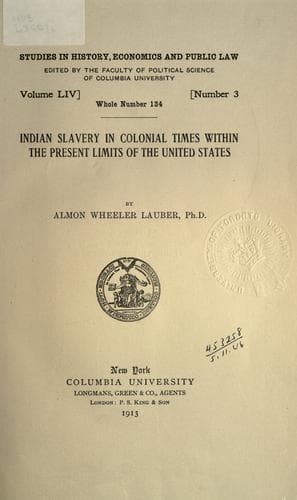
Indian slavery in colonial times within the present limits of the United StatesLauber, Almon Wheeler
History
Indian slavery in colonial times within the present limits of the United States
Lauber, Almon Wheeler
Indians of North America; Indians, Treatment of -- United States; Slavery -- United States; Thesis (Ph. D.)
[530] Church, _op. cit._, Dexter edition, i, p. 182, mentions the sale
of an old Indian named “Conscience” to a native of Swanzey. Perhaps an
exception was made in the case of this Indian, because of age. Another
exception appears to have been made by the Plymouth Court, September
1, 1676, when Sergeant Rogers was allowed to keep his Indian man at
his own house, provided he should produce the said Indian on demand of
the court. Hough, _op. cit._, p. 186. Still another exception was made
by the Plymouth Court at the same session granting Church the right to
“some five or six Indians,” who, if their behavior was satisfactory,
might remain in the colony and not be sold to foreign parts unless
any of them should be proved to have murdered any of the English.
One Indian named “Crossman” was especially mentioned, as he had been
accused of murdering Mr. Hezekiah Willet. _Plymouth Colony Records_,
xi, p. 242; Baylies, _op. cit._, ii, pt. iii, p. 188.
[531] Pamphlet published in Cambridge in 1677, now in possession of the
Boston Athenaeum. The full text is as follows:
“At a court held at Boston in New England, the 29th of March, 1677. The
council being informed that certain strange Indians, who have been in
Hostility against us, or have lived amongst such, are brought into this
Jurisdiction, and bought by several persons, which causeth much trouble
and fear to the Inhabitants where they reside, and may be of dangerous
consequence, not only to the Towns where they live, but to the whole
Jurisdiction, if not timely prevented:
“It is therefore Ordered that what person soever within this
Jurisdiction shall hereafter buy or keep above ten days after the
publication hereof, any such Indian, man or woman already bought,
above the age of twelve years, without allowance from authority, shall
besides the forfeit of such Indian or Indians, pay the fine of five
pounds to the Treasurer of the Country, and the Constables of the
several towns are ordered forthwith to publish this Order in their
Precincts.
By the Council, Edward Rawson, Secr.”
[532] _Plymouth Colony Records_, v, p. 253.
[533] _Ibid._, ix, p. 71.
[534] Sylvester, _op. cit._, ii, p. 259; _Plymouth Colony Records_, v,
p. 173. This action was opposed by Church, but without result.
[535] Sylvester, _op. cit._, ii, p. 259; _Plymouth Colony Records_, v,
p. 174. Church, _op. cit._, Dexter edition, i, p. 46.
[536] Belknap, _The History of New Hampshire_, i, pp. 143, 245; _New
Hampshire Provincial Papers_, i, p. 357; Williamson, _The History of
the State of Maine_, i, p. 539; Sylvester, _op. cit._, ii, pp. 339–340;
Shurtleff, _op. cit._, v, p. 115. Hubbard and Mather barely mention
this affair. Hubbard, _op. cit._, pt. ii, p. 28; Mather, _Magnalia_,
bk. 7, ch. 6. Williamson states that the propriety of the event was
a “subject which divided the whole community; some applauded, some
doubted, some censured, but the government approved.”
Public-domain text, read in full here on John Shaqi.
Reviews
Reviews
No reviews yet
Be the first to share your thoughts on this work.
Elsewhere in the archive
Join the Discussion
Join the discussion
Sign in to leave a comment or review.
Sign InorCreate an account