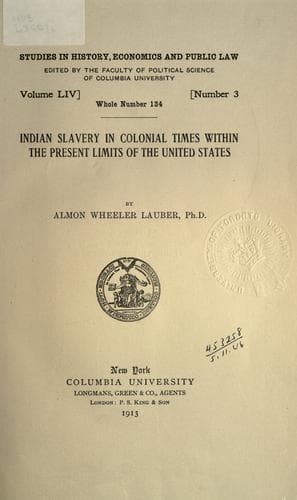
Indian slavery in colonial times within the present limits of the United StatesLauber, Almon Wheeler
History
Indian slavery in colonial times within the present limits of the United States
Lauber, Almon Wheeler
Indians of North America; Indians, Treatment of -- United States; Slavery -- United States; Thesis (Ph. D.)
[537] Ellis and Morris, _King Philip’s War_, p. 287; Baylies, _op.
cit._, ii, pt. iii, p. 190. In at least one instance, provision
against their being sold as slaves was made by the Indians in the
terms of their surrender. When the squaw-sachem, Awanthonks, deserted
the cause of Philip and allied herself with the English, she obtained
a promise from the Plymouth government “that the life of every man,
woman and child shall be spared, and none shall ever be sold as slaves,
or transported from their native soil.” Hough, _op. cit._, p. 20;
Drake, _The Book of the Indians_, ninth edition, p. 252; Freeman,
_Civilization and Barbarism_, p. 129.
[538] Shurtleff, _op. cit._, v, p. 136; _Plymouth Colony Records_, v,
pp. 207, 223.
[539] _Connecticut Colonial Records_, ii, 1665–1677, pp. 297–298.
Indians convicted of having murdered any of the English were to be put
to death, as in Massachusetts and Plymouth.
[540] _Connecticut Colonial Records_, ii, 1665–1677, pp. 481–482. At
this meeting the council granted liberty to ten Indians who had been
captured in a swamp where they had hidden.
[541] _Records of the Colony of Rhode Island and Providence Plantations
in New England_, i, p. 243; Richman, _Rhode Island, its Making and its
Meaning_, ii, p. 192.
[542] _Records of the Colony of Rhode Island and Providence
Plantations_, ii, p. 534.
[543] “Because it is said they were left as hostages to the English
force of the United Colonies.” Hough, _op. cit._, p. 186.
[544] Action was taken in accordance with the powers granted in the
charter “to exercise the law martial in such cases as occasions shall
necessarily require, and upon just cause, to invade and destroy the
native Indians and other enemies of the said colony.” Hough, _op.
cit._, p. 173 _et seq._
[545] _Records of the Colony of Rhode Island and Providence
Plantations_, ii, pp. 549–551.
[546] _Early Records of the Town of Portsmouth_, p. 188. Rhode Island
was accustomed to sell both whites and Indians into temporary servitude
as punishment for crime. The Indians here mentioned were probably
examples of such cases. See _Rhode Island Tracts_, No. 18, p. 131. The
towns appears to have reversed its policy later. See Weeden, _Early
Rhode Island_, etc., p. 178.
It was politic for the colonial governments to oppose the enslavement
of Indians who were friendly to the English or in alliance with them.
Two such instances are recorded in connection with North Carolina. In
1713, at the request of the governor of New York, the Seneca Indians
sent an Indian to the Tuscarora to caution them against going to war
with the English. The South Carolina Indians captured this Indian and
held him as a slave. The council decided to buy him and send him back
to his own nation. _North Carolina Colonial Records_, ii, pp. 1–2.
In the same year the council ordered that a colonist who had sold a
friendly Indian as a slave should be held for trial. _Ibid._, ii, p. 55.
Public-domain text, read in full here on John Shaqi.
Reviews
Reviews
No reviews yet
Be the first to share your thoughts on this work.
Elsewhere in the archive
Join the Discussion
Join the discussion
Sign in to leave a comment or review.
Sign InorCreate an account