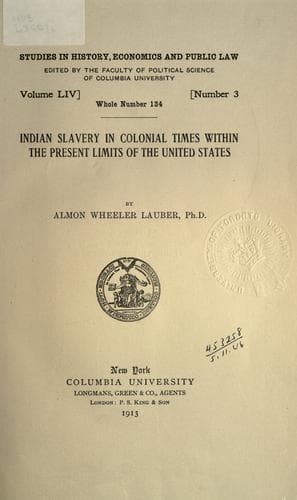
Indian slavery in colonial times within the present limits of the United StatesLauber, Almon Wheeler
History
Indian slavery in colonial times within the present limits of the United States
Lauber, Almon Wheeler
Indians of North America; Indians, Treatment of -- United States; Slavery -- United States; Thesis (Ph. D.)
[621] Chalmers, _op. cit._, in Carroll, _op. cit._, ii, p. 314. This
special letter of the proprietors was called forth by Captain Godfrey’s
treatment of the Indians, and by the opinions of private individuals
expressed in letters to them. The proprietors had already struck a blow
at the council by giving the parliament a right to punish members of
the council for misbehavior. The council had complained of this to the
proprietors, who in turn asserted that the Indian dealers (members of
the council) feared lest the parliament have too much power over them.
Archdale, _A New Description_, etc., in Carroll, _op. cit._, ii. p. 100.
[622] _Calendar of State Papers_, colonial series, xi, pp. 508–510.
[623] _Calendar of State Papers_, colonial series, xi, pp. 508–510.
[624] Archdale, _op. cit._, in Carroll, _op. cit._, ii, p. 107; Hewat,
_op. cit._, i, p. 78; _Calendar of State Papers_, colonial series, xi,
p. 508; _Public Records of South Carolina_, i, 1663–1684, p 266; _B.
P. R. O._, _Colonial Entry Book_, xxii, p. 20. _The Journal of the
English Board of Trade_, vol. xi, p. 174, under the date August 19,
1698, and the marginal heading _American Indian Slaves_, contains the
following direction to the governor of Bermudas: “And upon observation
made that it is commonly said there are many Americans at Bermuda kept
as slaves; ordered, that the governor be required to give an account,
what number there are of them, from whence they are bought and by whom
imported.” The governor’s reply was a mere tabulation of slaves, with a
statement of their sex and the locality in which they resided, without
any special reference to Indian slaves. No further reference was made
to the matter by the Board of Trade.
[625] Rivers, _op. cit._, appendix, p. 456.
[626] O’Gorman, _A History of the Roman Catholic Church in the United
States_, p. 39.
[627] Rivers, _op. cit._, appendix, p. 456; _North Carolina Colonial
Records_, ii, p. 904. The complaint read: “ruined trade in skins and
furs (whereby we held our chief correspondence with England) and turned
it into a trade of Indians or slave making, whereby the Indians to the
south and west of us are already involved in blood and confusion, a
trade so odious and abominable, that every colony in America (although
they have equal temptation) abhor to follow.”
[628] Logan, _op. cit._, i, p. 172.
[629] _State of the British and French Colonies in North America_, p.
25.
[630] _New England Historical and Genealogical Register_, 1859, xiii,
p. 300.
[631] Thomas, _op. cit._, ii, pp. 95–100; _Journal of the Board of
Trade, British Public Record Office_, Co. 391. 25 R., xvii. p. 168.
Public-domain text, read in full here on John Shaqi.
Reviews
Reviews
No reviews yet
Be the first to share your thoughts on this work.
Elsewhere in the archive
Join the Discussion
Join the discussion
Sign in to leave a comment or review.
Sign InorCreate an account