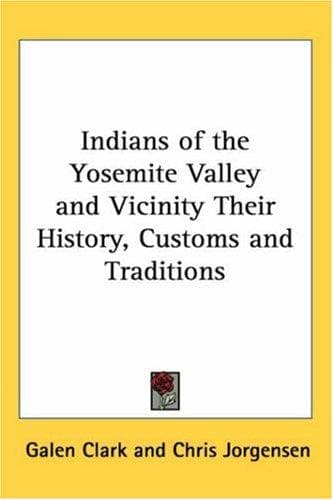
Indians of the Yosemite valley and vicinity: Their history, customs and traditionsClark, Galen
History
Indians of the Yosemite valley and vicinity: Their history, customs and traditions
Clark, Galen
Indians of North America -- California; Yosemite Valley (Calif.)
When I joined the Indians in camp that night I inquired of them
about the sound I had heard. They replied that it was not a
dog--that a long time ago an Indian boy had been drowned in the
lake, and that every time any one passed there he always cried
after them, and that no one dared to go in the lake, for he
would catch them by the legs and pull them down and they would,
be drowned. I then concluded that it must have been some unseen
water-fowl that made the cry, and at that time I thought that the
Indians were trying to impose on my credulity, but I am now
convinced that they fully believed the story they told me.
Po-ho'-no Lake, the headwaters of the Bridal Veil Creek, was
also thought to be haunted by troubled spirits, which affected
the stream clear down into the Yosemite Valley; and the Indians
believed that an evil wind there had been the cause of some fatal
accidents many years ago. The word Po-ho'-no means a puffing
wind, and has also been translated "Evil Wind," on account of the
superstition above referred to.
LEGEND OF THE LOST ARROW.
Tee-hee'-nay was a beautiful Ah-wah'-nee maiden, said to be
the most beautiful of her tribe, and she was beloved by
Kos-su'-kah, a strong and valiant young brave. Valuable
presents had been made to the bride's parents, and they had given
their consent to an early marriage, which was to be celebrated by
a great feast.
To provide an abundance of venison and other meat for this
banquet, Kos-su'-kah gathered together his young companions and
went into the mountains in search of game. In order that
Tee-hee'-nay might know of his welfare and the success of the
hunt, it was agreed between the lovers that at sunset Kos-su'-kah
should go to the high rock to the east of Cho'-lak [Yosemite
Falls], and should shoot an arrow into the Valley, to which
should be attached a number of grouse feathers corresponding to
the number of deer that had fallen before the skill of the
hunters.
[Illustration: _Photograph by Fiske_.
BRIDAL VEIL FALL (PO-HO'-NO). 940 Feet.
The-source of this stream is supposed by the Indians to be
haunted by troubled spirits, which affect the water along its
whole course. The word Po-ho'-no means a "puffing wind."]
At the time appointed Tee-hee'-nay went near the foot of the
great cliff and waited, with her eyes raised to the towering
rocks above, hoping with her keen sight to see the form of her
lover outlined against the sky, but no form could she see, and no
arrow fell into the Valley. As darkness gathered, gloomy
forebodings took possession of her, and she climbed part way up
the canyon called Le-ham'-i-tee [now known as Indian Canyon]
because the arrow-wood grew there, and finally she stood at the
very foot of the rocky wall which rose to dizzy heights above
her, and there she waited through the long night.
Public-domain text, read in full here on John Shaqi.
Reviews
Reviews
No reviews yet
Be the first to share your thoughts on this work.
Join the Discussion
Join the discussion
Sign in to leave a comment or review.
Sign InorCreate an account